


UN Committee says Ebola in DR Congo still an international public health emergency
New York/IBNS: The Ebola outbreak in the eastern Democratic Republic of the Congo (DRC) officially remains a Public Health Emergency of International Concern, experts meeting in Geneva said on Friday.
The World Health Organization (WHO) convened its Emergency Committee on the disease which concluded with a call for sustained political commitment and continued cross-border screenings, among other recommendations.
The outbreak began in August 2018 and there have been 3,114 confirmed cases and 2,123 deaths, according to latest figures.
It is occurring in an area long affected by armed group activity, making insecurity the greatest concern.
While Ebola risk remains “very high” at the national and regional levels, it is still low globally, WHO said in a statement following the meeeting.
WHO’s commitment is to supporting #DRC to strengthen its health system, as the foundation of a healthier, safer and fairer DRC.
Cases have consistently declined in recent weeks: 15 new cases were reported during the period 7 – 13 October, compared with 128 confirmed cases per week during the peak of the outbreak in April.
Additionally, “hot spots” have shifted from urban settings to more rural, hard-to-reach communities across a more concentrated geographical area.
Currently, 10 “health zones” are affected and WHO said these areas pose “major” security challenges.
“When response activities are suspended, the likelihood of under-reporting and the potential for the disease to spread to new areas increases,” the agency said. “In addition, continued transmission in remote areas where access is difficult creates the possibility of transmission chains going undetected.”
An experimental vaccine known as rVSV-ZEBOV-GP is being used in the outbreak and has been shown to be effective in protecting people from the Ebola virus. So far, more than 230,000 people have been innoculated, including more than 60,00 health and frontline workers in the DRC, Uganda, South Sudan, Rwanda and Burundi.
The meeting heard that a so-called “ring” strategy is also proving effective. This involves vaccinating all people who come into contact with a person who has Ebola.
Separately on Friday, WHO welcomed the European Medicines Agency (EMA) recommending conditional marketing authorization for the vaccine: a key step before licensing and roll-out.
“This vaccine has already saved many lives in the current Ebola outbreak, and the decision by European regulator will help it to eventually save many more,” said WHO Director-General Tedros Adhanom Ghebreyesus.
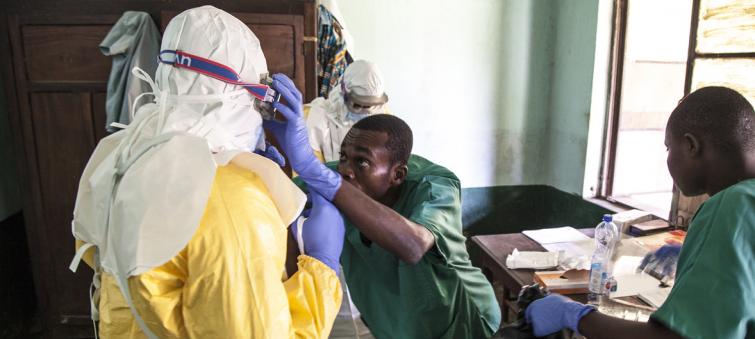
Photo caption and credit:
UNICEF/Naftalin
Health workers prepare to treat suspected Ebola patients in Bikoro Hospital in the Democratic Republic of the Congo
Support Our Journalism
We cannot do without you.. your contribution supports unbiased journalism
IBNS is not driven by any ism- not wokeism, not racism, not skewed secularism, not hyper right-wing or left liberal ideals, nor by any hardline religious beliefs or hyper nationalism. We want to serve you good old objective news, as they are. We do not judge or preach. We let people decide for themselves. We only try to present factual and well-sourced news.
Support objective journalism for a small contribution.


