


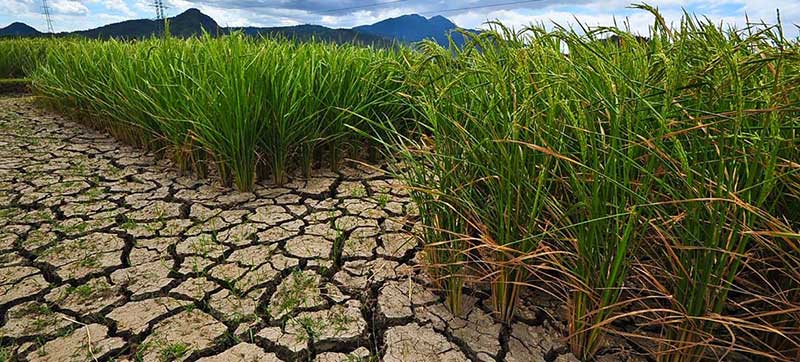
 Asia Warming
Warming trend in Asia set to cause more disruption: UN weather agency
New York: Climate change impacts are increasing in Asia, which is warming faster than the global average, the World Meteorological Organization (WMO) said in a new report published on Thursday.
Melting ice and glaciers and rising sea levels threaten more socio-economic disruption in future, according to the agency’s latest State of the Climate report for the region.
The mean temperature over Asia for 2022 was the second or third warmest on record and was about 0.72 degrees Celsius (°C) above the 1991–2020 average, which was itself roughly 1.68°C above the WMO 1961–1990 reference period for climate change.
Drought, disasters and death
Asia is also the world’s most disaster-prone region, according to the agency’s new report.
Tweet URL
In 2022, there were more than 80 disasters on the continent, mainly floods and storms, which killed upwards of 5,000 people and affected 50 million more. Overall economic damage exceeded $36 billion.
WMO Secretary-General Petteri Taalas said many areas in Asia experienced drier-than-normal conditions and drought last year.
He highlighted the case of China, where prolonged drought conditions affected water availability and the power supply. The estimated economic losses were over $7.6 billion.
“Most glaciers in the High Mountain Asia region suffered from intense mass loss as a result of exceptionally warm and dry conditions in 2022. This will have major implications for future food and water security and ecosystems,” he added.
Devastating losses in Pakistan
Last year also saw severe flooding in Pakistan. The country received 60 per cent of its normal monsoon rain within just three weeks of the start of the monsoon season last June.
More than 33 million people were affected, or roughly 14 per cent of the population, and more than $15 billion in losses were recorded. National authorities put the death toll at over 1,730, while nearly eight million people were displaced.
Asia also shows an overall surface ocean warming trend beginning in 1982. In the northwestern Arabian Sea, the Philippine Sea and the seas east of Japan, the warming rates exceed 0.5°C per decade, roughly three times faster than the global average.
Focus on agriculture
The report was released during a meeting of the UN Economic and Social Commission for Asia and the Pacific’s (ESCAP) Committee on Disaster Risk Reduction. It is accompanied by an interactive story map, with a special focus on agriculture and food security.
WMO said the expected increase in the frequency and severity of extreme events over much of Asia will impact agriculture, which is central to all climate adaptation planning.
Support Our Journalism
We cannot do without you.. your contribution supports unbiased journalism
IBNS is not driven by any ism- not wokeism, not racism, not skewed secularism, not hyper right-wing or left liberal ideals, nor by any hardline religious beliefs or hyper nationalism. We want to serve you good old objective news, as they are. We do not judge or preach. We let people decide for themselves. We only try to present factual and well-sourced news.
Support objective journalism for a small contribution.


