


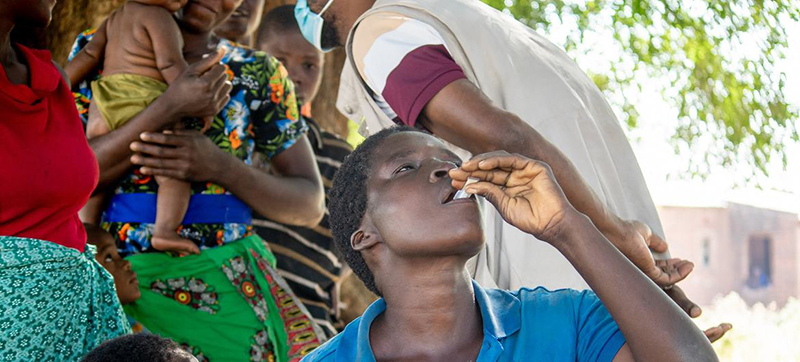
 Image: Unicef Malawi
WHO reports exponential rise in cholera cases in Africa
New York: Africa is currently experiencing an exponential rise in cholera cases, amid a global surge in the disease, the World Health Organization (WHO) reported on Thursday.
Across the continent, cases in January were 30 per cent higher than for the whole of last year.
Most new infections and deaths have occurred in Malawi, which is facing its worst outbreak in 20 years.
10 countries affected
Overall, 10 African countries are affected by cholera. The waterborne disease causes acute watery diarrhoea and can kill within hours but is easily treatable.
Besides Malawi, cases have been reported in neighbouring Mozambique and Zambia, as well as in Burundi, Cameroon, the Democratic Republic of the Congo (DRC) and Nigeria.
Ethiopia, Kenya and Somalia are also responding to outbreaks amid the historic drought in the Horn of Africa which has left millions in dire need of humanitarian assistance.
‘A worrying scenario’
“We are witnessing a worrying scenario where conflict and extreme climatic events are worsening the triggers of cholera and increasing its toll on lives,” said Dr. Matshidiso Moeti, WHO Regional Director for Africa.
As of 29 January, an estimated 26,000 cases and 660 deaths have been reported in the 10 countries.
WHO warned that if the current trend continues, cases could surpass the number recorded in 2021 - the worst year for cholera in Africa in nearly a decade.
The average case fatality ratio is almost at three per cent, which is above the 2.3 per cent reached in 2022 and far exceeds the acceptable level of below one.
“It’s critical for African countries to scale up readiness to quickly detect cases and mount comprehensive and timely response,” said Dr. Moeti.
Support to Malawi
WHO is helping governments to fight back, including ramping up disease surveillance, prevention and treatment, and community engagement.
Sixty-five experts have been deployed to five countries, 40 alone to Malawi, where nearly 37,000 cholera cases and 1,210 deaths have been reported in all 29 districts since last March.
Additionally, WHO has distributed cholera kits and other supplies there, including oral rehydration salts, IV fluids, antibiotics, rapid diagnostic test kits, personal protective equipment, tents and cholera beds.
It has also helped to provide nearly 50 rehydration points in vulnerable communities, and supported the recruitment of dozens of doctors, nurses and clinical technicians across the country.
More investment needed
Furthermore, WHO also disbursed $6 million to kick-start emergency cholera response in Malawi, Kenya and Mozambique, through an international partnership on vaccines known as the ICG.
The increase in cholera outbreaks globally has put a huge strain on the availability of oral vaccines to treat the disease.
In October, the ICG temporarily suspended the standard two-dose regimen to a single dose approach. A further surge in cholera risks deepening the shortage.
“Every death due to cholera is preventable,” said Dr Moeti. “This disease is as much a health challenge as it is a development one. As such investments in better sanitation and access to safe water, formidably complement the public health initiatives to sustainably control and end cholera.”
Support Our Journalism
We cannot do without you.. your contribution supports unbiased journalism
IBNS is not driven by any ism- not wokeism, not racism, not skewed secularism, not hyper right-wing or left liberal ideals, nor by any hardline religious beliefs or hyper nationalism. We want to serve you good old objective news, as they are. We do not judge or preach. We let people decide for themselves. We only try to present factual and well-sourced news.
Support objective journalism for a small contribution.


