Book review: A discourse on school education at crossroads
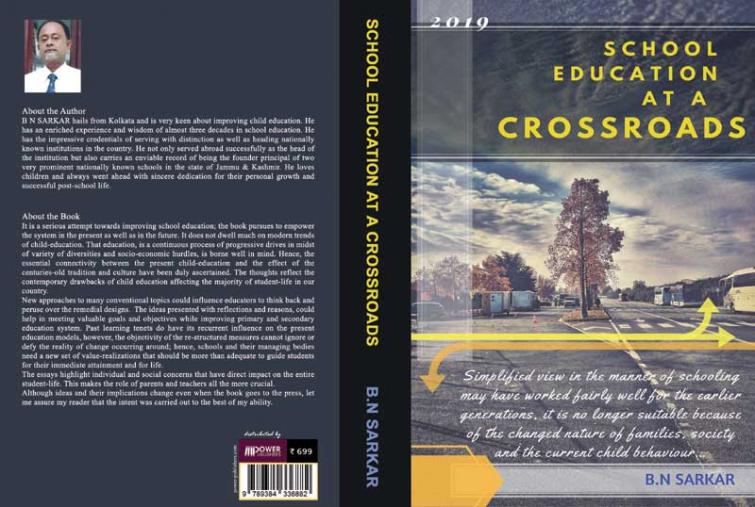
Only education can eradicate narrow-mindedness, superstitions and ignorance and help society to progress further, says Biswanath Sarkar in his book, ''School Education at Crossroad: A Collection of Essays".
One’s formal education commences when one joins school at an early age and continues till university or even more.
However, the standard and uniformity of school education needs to be maintained to give quality education and other facilities related to it to the students.
The standard of society and its development depends on the way a particular subject or information is delivered to the students by the teachers.
India Today in November 2006 edition had said, “If we want to transform our society, we will have to change what we teach and how we teach.”
Apart from quality education, the management must also look after the other important aspects like proper drinking water facility, sanitation, hygiene, playground, laboratories, libraries, auditorium so that the students get an appropriate place to study for an all-round development.
Biswanath Sarkar has carefully divided the book into 18 chapters, each dealing with a relevant topic.
Sarkar deals with the education system post Indian independence and traces the difference between the education system pre and post 1947.
The book concludes with the issue of the crucial phase of school education in the province of Kashmir.
It can be anticipated that education can bring in peace that will strengthen the individuals and the society at large.
This essay highlights all the burning issues of the present times and education is put forward as one of the best means to have a developed and peaceful society.
Children are the future of our nation, hence if they receive proper education and a proper school environment, they can flourish and help the country to grow in future.
Sarkar has used lucid language to construct the essay and he has provided ample examples so that readers can easily understand the content and think about it to make a change.
Reviewed by Sayantani Sengupta
Support Our Journalism
We cannot do without you.. your contribution supports unbiased journalism
IBNS is not driven by any ism- not wokeism, not racism, not skewed secularism, not hyper right-wing or left liberal ideals, nor by any hardline religious beliefs or hyper nationalism. We want to serve you good old objective news, as they are. We do not judge or preach. We let people decide for themselves. We only try to present factual and well-sourced news.
Support objective journalism for a small contribution.