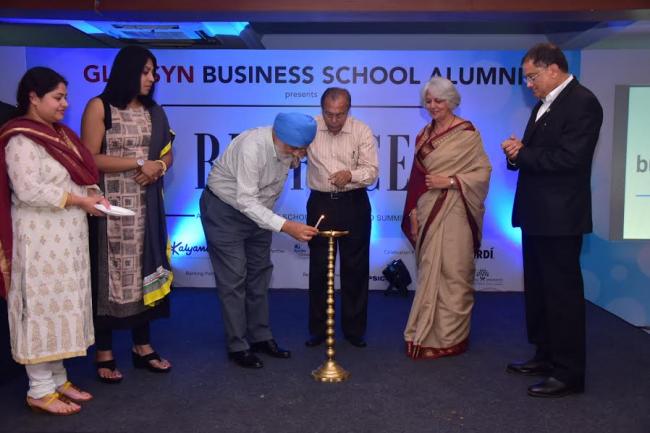
Brand Summit by Globsyn alumni to strengthen B-school
Called RETRACE, the Summit – organised at the Lake Land Country Club – not only aimed to bring together the alumni but also to bring together the alumni, entrepreneurs and corporates to deliberate on future plans for Globsyn Alumni Engage Initiative.
The event on Sunday began with Dr Bikram Dasgupta, Chairman – Governing Council, GBS, delivering the Welcome Address. He highlighted on the history of GBS, which was founded in 2002 with 54 students.
Having seen GBS develop over the past few years into a leading business school, he was eager to pass on the reins to the alumni, who he believed, “will not only take the Globsyn Business School Brand forward but also help shape the future of hundreds of youngsters who will be joining the school in the coming years.”
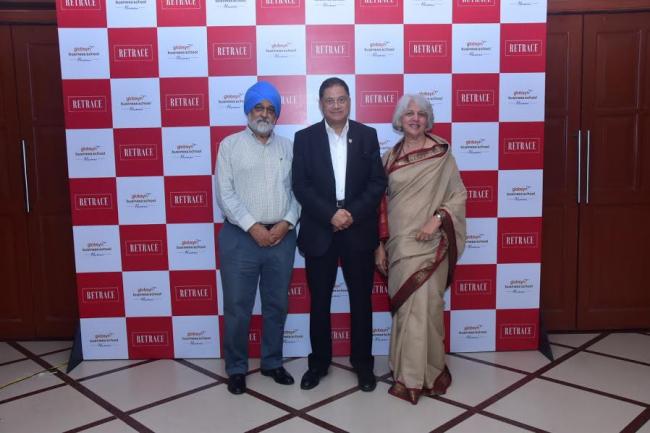 Dr Montek Singh Ahluwalia, former Deputy Chairman of the Planning Commission, Government of India, spoke on Digital India and the Effects of Digitalisation on the Indian Economy.
He highlighted that digitalisation is an inescapable feature today; for example, app-based functions are becoming increasingly popular in India and entering into almost every sphere of life, from mobile banking to local transportation.
He said while the effects of digitalisation are bringing about a positive change, people will accept it willingly but not when it is acting in a disruptive fashion.
In a labour-intensive country like India, if digitalisation leads to loss of jobs or people cannot be employed owing to lack of proper skills, then people will oppose it.
“While private banks have the scope and capability to use digitalisation to improve on functioning and business,” said Dr Ahluwalia, “government banks, most of whom are burdened with legacy functions, may not be able to implement digitalisation fast enough and therefore lose out in competition.”
To pursue the dream growth numbers and compete with the rest of the world, India has to speed up its journey on the digital highway, insisted Dr Ahluwalia and warned that it is quite possible that many jobs that are common today may become irrelevant or not be there in the next 15 years.
He also said that while it is important that the government takes up skill development policies, it is equally important that the education system start preparing the young generation for the challenges ahead.
Strengthening basic education in the country is very important, he said, “because if a person is not able to follow the instructions in a manual, how will he or she, work?”
According to Dr Ahluwalia, the mind-set of most trade unions, who oppose the idea of having apprentices, must change as that is the one of the best ways a young person can learn about the job.
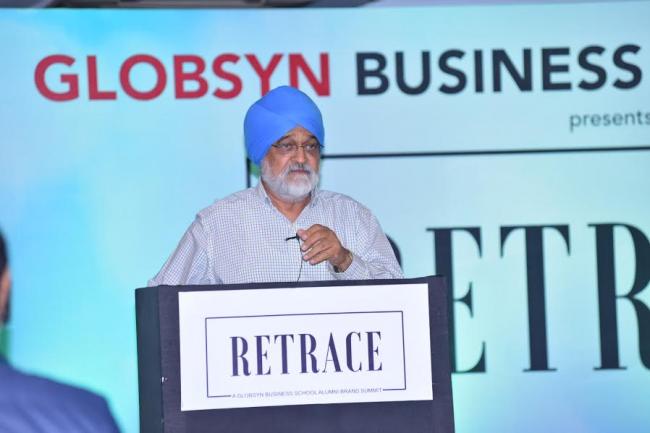 In conclusion, he said, “Digitalisation, so long it is not disruptive, is not important but when it is disruptive, there is bound to be dissatisfaction, and then it is a matter of concern.”
Dr Isher Judge Ahluwalia, Chairperson of Indian Council of Research on International Economic Relations (ICRIER) spoke on the state of Indian cities.
She pointed out that while India is planning on Smart Cities, most urban centres lack basic civic facilities such as safe drinking water, adequate medical attention and proper sewage disposal.
“It is very well to say you are improving the investment climate but if your children are exposed to many kinds of viruses, then what good will that do,” she asked the gathering.
On the other hand, she also refused to accept the common complaints that no good work can be done in India because of lack of funds or because ‘politics comes in the way’.
She gave examples of places like Alandur in Tamil Nadu and Malkapur in Maharashtra where enabling state government policies helped improve the city’s civic facilities.
Like her previous speaker, Dr Isher Judge Ahluwalia also emphasised that basic education has an important role to play in spreading the message of civic sense that will help to turn all our urban centres into smart cities of the future.
The entire programme was well coordinated by Shabbir Akhtar.
Image: At the GBS Brand Summit, Kolkata
Support Our Journalism
We cannot do without you.. your contribution supports unbiased journalism
IBNS is not driven by any ism- not wokeism, not racism, not skewed secularism, not hyper right-wing or left liberal ideals, nor by any hardline religious beliefs or hyper nationalism. We want to serve you good old objective news, as they are. We do not judge or preach. We let people decide for themselves. We only try to present factual and well-sourced news.
Support objective journalism for a small contribution.