October 05, 2026 05:59 am (IST)

Follow us:


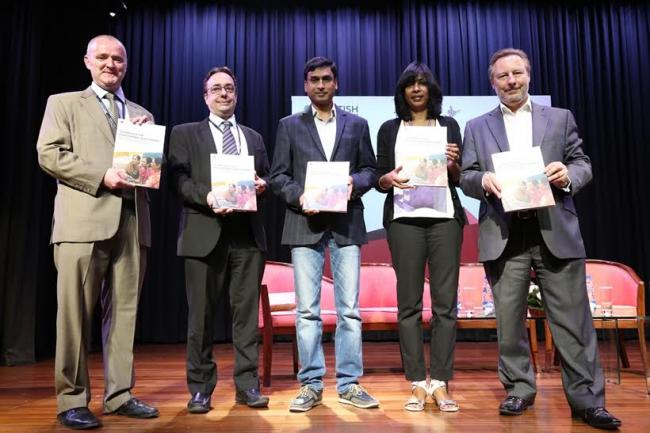
British Council with Open University co-host an evening to discuss development of teachers
New Delhi, Oct 6 (IBNS): The British Council in collaboration with The Open University co-hosted an event to encourage debate and discussion around the use of technology for teachers' professional development and within the classroom.
The Open University showcased the TESS-India project, which focuses on the development of OERs for teachers of English, maths and science.
At the event, the British Council launched a report on a recent research on the access teachers across South Asia have to ICT and how they can best leverage this access to support them within their professional development.
The purpose of the event was to enable an understanding of the use of technology in teacher education and the debates which surround it. The event highlighted the work of the British Council and The Open University / TESS-India in the use of technology in education (OERs, digital research and MOOCs). It also facilitated the networking of partners from academia, government and NGOs to further the understanding and use of technology in education.
The event also included a panel discussion which was chaired by Tom Power – Programme Director, English in Action, The Open University, Loveleen Kacker – CEO Tech Mahindra Foundation, Chris Cavey – Open Learning Manager, British Council UK, Rashmi Menon – Research Manager, Central Square Foundation and Atanu Bhattacharya – Chairperson, Centre for English Studies, Central University of Gujarat.
Rob Lynes, Director, British Council, said, “The British Council is delighted to co-host debate and discussion with The Open University on use of technology for teachers’ professional development. We have always worked towards development of teachers. They are the handlers of our future, it is imperative for them to develop themselves.”
"There is a global agreement on the need to provide education for all have shifted from a focus on access to an emphasis on the need for quality in order to ensure that learners are not only in classrooms, but are also experiencing teaching which will lead to successful learning. Research has shown that focusing on the development of teachers can have a significant impact on learning outcomes. It is also widely recognised that the use of digital technology can facilitate this development, from simply enabling better communication between teachers to revolutionising whole systems of teacher education," an official statement said.
In addition to the panel discussion, the British Council launched a report entitled Technology for professional development: access, interest and opportunity for teachers of English in South Asia.
The report highlights findings from research conducted by ZingerLabs and EZVidya in 2014. This included a detailed survey of 892 teachers from six countries – Afghanistan, Bangladesh, India, Nepal, Pakistan and Sri Lanka – investigating their access, attitudes and preferences with regards to using radio, TV, mobile, computers and social media for their development. The survey was supported by a series of fourteen focus groups in seven locations and interviews with industry experts and school leaders. Additionally, the team conducted secondary research into national trends and existing initiatives which are harnessing technology for educational purposes in the South Asia region.
Support Our Journalism
We cannot do without you.. your contribution supports unbiased journalism
IBNS is not driven by any ism- not wokeism, not racism, not skewed secularism, not hyper right-wing or left liberal ideals, nor by any hardline religious beliefs or hyper nationalism. We want to serve you good old objective news, as they are. We do not judge or preach. We let people decide for themselves. We only try to present factual and well-sourced news.
Support objective journalism for a small contribution.



Latest Headlines
Thiagarajar Polytechnic College receives Education Excellence Award for the fifth time
Mon, Sep 21 2026
Sona College of Tech, Salem team wins Mitsubishi contest for factory automation; beats 6 national winners across Asia
Fri, Sep 18 2026
No coaching, broken home, big dreams: How an Odisha family sent 5 children to medical college
Tue, Sep 15 2026
India’s deep-tech push goes global: 37 startups showcase innovation at BRICS Summit
Fri, Sep 11 2026
No industry skills after college? This government scheme offers paid apprenticeships and job opportunities
Fri, Sep 11 2026
IISWBM MSW Programme: Internships, Industry Exposure and Career Opportunities Explained
Sun, Sep 06 2026