Gandhi as seen through the lens of traditional Indian artists
Kolkata, July 31 (UNI): Rabindranath Tagore and Mahatma Gandhi shared a unique bond though they vastly differed on ideas of nationalism.
West Bengal held a great importance in the life of the Mahatma as it gave him two of his most famous epithets – Father of the Nation by Netaji Subhash Chandra Bose and Mahatma by the Nobel laureate. Gandhi in turn addressed the bard as Gurudev.
Despite ideological differences, the two 19th century greats shared a beautiful relationship.
This bonhomie between Mahatma and Gurudev has been stunningly captured in an intricate Sanjhi artwork by Mr Vijay Kumar Verma, an award winning artist from Mathura. The Sanjhi art piece, along with many other traditional paintings, is part of an ongoing exhibition in Kolkata to mark the 150th birth anniversary of Mahatma Gandhi.
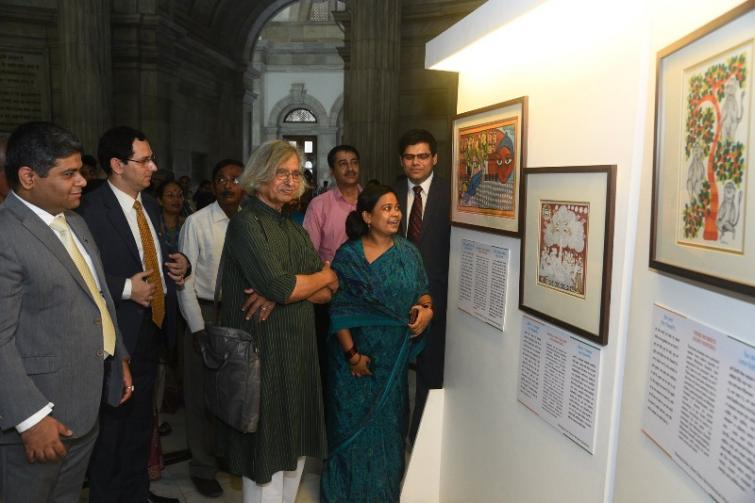
The traditional art exhibition on the life of the Mahatma, curated by Export-Import Bank of India (Exim Bank), is currently on at the Victoria Memorial Hall. It is being jointly organised by the Bank and VMH. Inaugurated on July 22 by renowned artist and Rajya Sabha member Jogen Chowdhury, the exhibition will be open to public till August 10.
.jpg)
The painting exhibition titled ‘Relive the Ideals of the Mahatma through Art’ will not only provide an opportunity to the residents of Kolkata for a rendezvous with the milestone events from the Mahatma’s life but also share lessons from his life with Indian and foreign tourists, who visit the Victoria Memorial Hall.
Interestingly, the exhibition will also feature a Pattua painting by Ms. Mamani Chitrakar, an artist from Medinipur district, depicting the unfortunate incident of Gandhi being thrown out of a train in South Africa.
The exhibition is the fourth in a series of similar ones organized by the Exim Bank around the country to observe Mahatma Gandhi's 150th birth anniversary. The first exhibition in the series was held in Delhi and inaugurated on Gandhi's death anniversary on January 30 (Martyrs’ Day).
The second exhibition was held on the death of anniversary of Kasturba Gandhi on February 22 at the Aga Khan Palace in Pune, while the third was held at the Sabarmati Ashram in Ahmedabad, coinciding with the anniversary of 'Dandi March'.
.jpg)
The exhibitions have together received more than 8,000 visitors who have appreciated the paintings in traditional art forms. An art enthusiast from Sydney, Australia, Mr. Martin Coxell, remarked, “Wonderful tribute to a remarkable man,” after seeing the paintings at Pune.
Mr. Nirmal Pandey, a historian from New Delhi, said, “The idea to present 12 different traditional Indian art forms on the theme of Mahatma Gandhi under one room in itself is commendable.” Mr. Naresh Gulati, an Ahmedabad-based art critic commented, “The good thing is that the works are accompanied by a narration highlighting the characteristics of the origin and style of the art forms deployed by the artists of the series, some of which are just mesmerizing for the minutiae and detail.”
Exim Bank had engaged traditional artists from different nooks and corners of the country to develop these paintings, based on various events from Mahatma’s life. The exhibition provides a retrospect on some historical events and highlights important lessons from his life.
The artists representing 12 different traditional art forms [hailing from Dahanu in Maharashtra (for Warli painting), Kotra Sultanabad near Bhopal in Madhya Pradesh (for Gond painting), Kamrup in Assam (for North East weaving), Chandanpur in Odisha (for Pattachitra painting), Srinagar in J&K (for Papier Mache art), Triplicane in Tamil Nadu (for Tanjore painting), Mathura in Uttar Pradesh (for Sanjhi craft), Paschim Medinipur in West Bengal (for Pattua painting), Srikalahasthi in Andhra Pradesh (for Kalamkari painting), Ahmedabad in Gujarat (for Mata-Ni-Pachedi), Bhilwara in Rajasthan (for Phad painting) and Madhubani in Bihar (for Madhubani painting)] were commissioned for the project, and developed 25 exclusive paintings for Exim Bank.
Support Our Journalism
We cannot do without you.. your contribution supports unbiased journalism
IBNS is not driven by any ism- not wokeism, not racism, not skewed secularism, not hyper right-wing or left liberal ideals, nor by any hardline religious beliefs or hyper nationalism. We want to serve you good old objective news, as they are. We do not judge or preach. We let people decide for themselves. We only try to present factual and well-sourced news.
Support objective journalism for a small contribution.