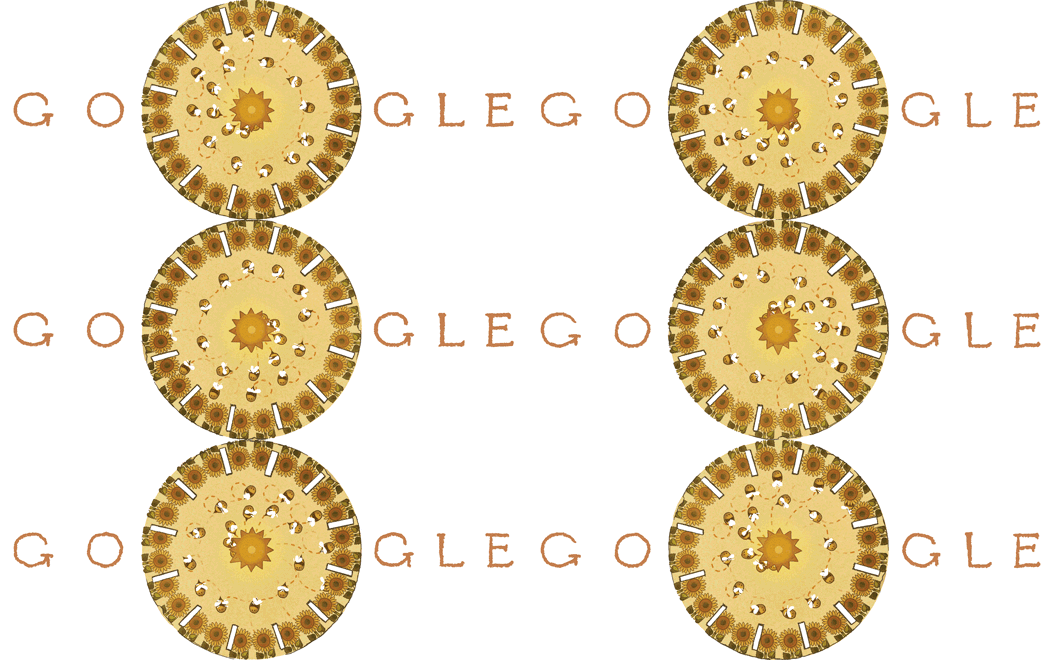
Google doodles to celebrate 218th birth anniversary of Belgian physicist Joseph Antoine Ferdinand Plateau
New York: World's popular search engine Google on Monday designed its homepage with an animate doodle to mark the 218th birthday of Belgian physicist Joseph Antoine Ferdinand Plateau.
His research on visual perception inspired him to invent a device he called the phénakistiscope, which led to the birth of cinema by creating the illusion of a moving image.
Inspired by the mesmerizing animated discs, the animated Doodle art was made to reflect Plateau’s style, with different imagery and themes in them on different device platforms.
The Google Doodle website said: "Born in Brussels on this day in 1801, Plateau was the son of an accomplished artist who specialized in painting flowers. After studying law, young Plateau became one of the best-known Belgian scientists of the nineteenth century, remembered for his study of physiological optics, particularly the effect of light and color on the human retina."
Plateau’s doctoral dissertation detailed how images form on the retina, noting their exact duration, color, and intensity.
Based on these conclusions, he was able to create a stroboscopic device in 1832, fitted with two discs that rotated in opposite directions.
One disc was filled with small windows, evenly spaced in a circle, while the other had a series of pictures of a dancer.
When both discs turned at exactly the right speed, the images seemed to merge, creating the illusion of a dancer in motion.
Support Our Journalism
We cannot do without you.. your contribution supports unbiased journalism
IBNS is not driven by any ism- not wokeism, not racism, not skewed secularism, not hyper right-wing or left liberal ideals, nor by any hardline religious beliefs or hyper nationalism. We want to serve you good old objective news, as they are. We do not judge or preach. We let people decide for themselves. We only try to present factual and well-sourced news.
Support objective journalism for a small contribution.