 IIT
IIT
IIT Guwahati researchers develop cost-effective, highly efficient perovskite solar cells to produce electricity from sunlight
Guwahati/IBNS: Indian Institute of Technology Guwahati (IIT-G) researchers have developed hybrid perovskite-based solar or photovoltaic devices to produce electricity from the sunlight, which are highly efficient, cost effective, easy to manufacture and easily recyclable.
These devices were developed achieving power conversion efficiencies beyond 21% by utilizing economical solution-based photovoltaic device processing techniques at mild room temperature and realizing high ambient, thermal and optical stability.
Among all the renewable energy sources, the energy from sun (solar energy) is considered to be the most sustainable due to its ample availability on the surface of the earth. Currently, inorganic solar cells (Silicon-based) are a major player in the market.
However, this technology requires high-temperature processing that results in the high price of solar panels. Further, the recycling of solar panels is hazardous and complicated.
The perovskite solar cells (PSCs) research has experienced tremendous attention due to their exponential growth in terms of efficiencies achieved within a decade. However, the perovskite materials are extremely unstable towards ambient (humidity and oxygen) conditions that restrict their commercialization.
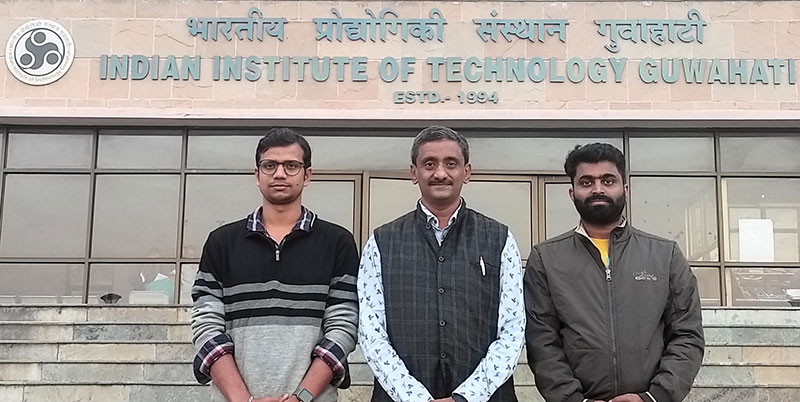
The research team at IIT Guwahati comprising of research scholars Rabindranath Garai (Department of Chemistry), Ritesh Kant Gupta (Centre for Nanotechnology), Arvin Sain Tanwar (Department of Chemistry), Maimur Hossain (Department of Chemistry) working under the supervision of Prof. Parameswar K. Iyer, Department of Chemistry and Centre for Nanotechnology and School for Health Science and Technology, IIT Guwahati, have achieved remarkable results in terms of efficiency and stability of the PSCs.
In this recent study of IIT Guwahati, published in the American Chemical Society journal Chemistry of Materials, 2021, 33, 5709-5717, charged conjugated polymers have been incorporated in photovoltaic devices as a passivation molecule to achieve defect-free high-quality perovskite solar cell devices.
The passivated defect-free device reveals a high efficiency of 20.17% with excellent reproducibility. Such polymer based passivation method effectively improved the long-term device stability by improving the hydrophobicity of the perovskite layer.
In another recent investigation of the IIT Guwahati team, published in The Royal Society of Chemistry journal Journal of Materials Chemistry A, 2021, 9, 26069-26076, the researchers demonstrated the development of solution-processed multi-dimensional (2D-3D) graded perovskites and the precise role of surface recrystallization to achieve very high efficiencies, stability, economical device scalability by mitigating the perovskite defects.
To achieve these remarkable performances, systematic design and development of functional molecules such as organic ammonium halide salt, 4-(aminomethyl) benzoic acid hydrogen bromide was used strategically to fabricate 2D-3D graded perovskite and investigated as device engineering and performance enhancement materials. 2D-3D graded device reveals an outstanding efficiency of 21.18% which are highly reproducible.
Moreover, the top 2D layer of the 2D-3D graded heterostructure efficiently improves the hydrophobicity and the corresponding device discloses almost negligible degradation under humid conditions. To check the practicality of these approaches, large-area devices with an active area ~2 cm2 resulted in high efficiency of over 18%, that can be arranged in an array to fabricate larger photovoltaic modules on flexible or rigid surfaces including as transparent windows in buildings.
Speaking about these research output, Prof. Parameswar K. Iyer, mentioned that organic-inorganic hybrid PSCs have experienced rapid growth in terms of efficiency and stability due to the development of highly efficient functional materials combined with careful device engineering. The materials design can be tailored at the molecular level whereas the fabrication process is printable and solution-based, making the overall solar cell development process economical and scalable.
These results obtained from perovskite solar cells have performed well beyond the commercial inorganic solar cells panels which are available in the market presently. Also, these small and large area devices performances are among the best results achieved using these classes of perovskite materials. Therefore, the strategies being developed have the potential to address the renewable energy challenges regarding the large-scale commercial fabrication of efficient and stable solar panels.
Support Our Journalism
We cannot do without you.. your contribution supports unbiased journalism
IBNS is not driven by any ism- not wokeism, not racism, not skewed secularism, not hyper right-wing or left liberal ideals, nor by any hardline religious beliefs or hyper nationalism. We want to serve you good old objective news, as they are. We do not judge or preach. We let people decide for themselves. We only try to present factual and well-sourced news.
Support objective journalism for a small contribution.