 Avataar
India AI Mission launches indigenous Varya. What is it?
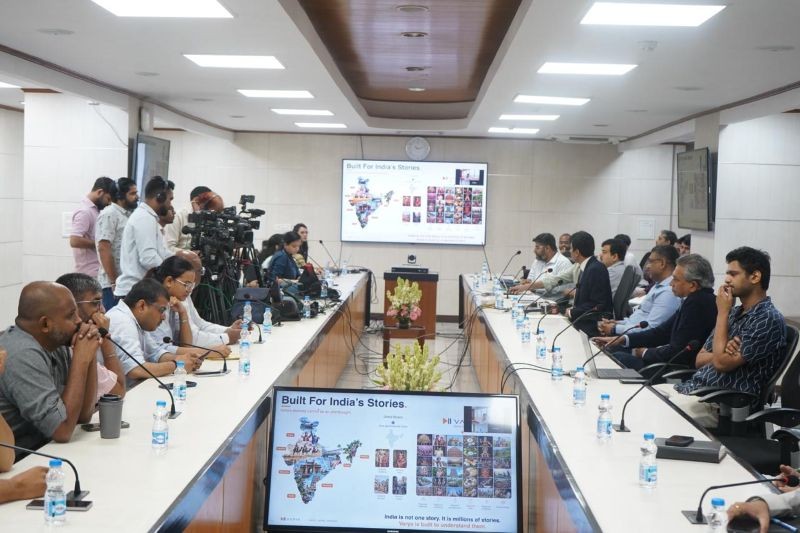
Avataar, an AI-native transformation company, on Friday unveiled Varya, a distilled video generation model designed to make frontier AI video technology more affordable, accessible, and contextually relevant for India’s next generation of users.
The launch was announced at a press event in New Delhi, attended by S. Krishnan, Secretary, Ministry of Electronics and Information Technology (MeitY), Government of India, along with senior leadership from Avataar.
India's AI innovation ecosystem continues to grow stronger.
— IndiaAI (@OfficialINDIAai) June 12, 2026
With support from the #IndiaAIMission, @Avataar has developed Varya, India's first distilled video model, marking an important milestone in India's AI innovation journey.
The model was launched today by Shri S… pic.twitter.com/zWBwSVuHlr
Positioned as a India-first innovation, Varya has been developed to understand and generate culturally nuanced visual content across India’s diverse regions, festivals, communities, food practices, clothing styles, public spaces, and everyday life. The company said the model moves beyond a generalized global AI approach, focusing instead on India-specific contexts and real-world use cases.
Avataar was among the companies selected under the IndiaAI Mission to develop indigenous foundation AI capabilities. Access to subsidised national AI compute infrastructure played a key role in enabling the research behind Varya, underscoring the government’s push to strengthen domestic deep-tech innovation.
According to the company, Varya is built on a distillation-based architecture that reduces video generation steps from around 50 to just 4, significantly improving efficiency while maintaining output quality. Internal benchmarks indicate that the model can generate video at approximately ₹0.48 per second, making it up to 10 times more cost-efficient than several leading global video models.
The platform is built around a simple workflow—Idea → Video → Story—enabling users to generate videos from text prompts or images and extend them into multi-clip narratives. Its use cases span educational content, advertising, storytelling, and public information dissemination.
Speaking at the launch, MeitY Secretary S. Krishnan said the initiative marks a significant milestone in India’s AI journey, adding that Varya reflects the government’s commitment to fostering indigenous, research-led AI capabilities and enabling innovation at scale.
Avataar Co-founder and CEO Sravanth Aluru said Varya demonstrates that frontier-level video AI can be made significantly more efficient and accessible. He added that affordability is essential for building AI products at population scale in a country of over 1.4 billion people.
The company further stated that “affordable AI is inclusive AI,” emphasizing that India’s AI opportunity lies not only in building larger models, but also in developing efficient, context-aware systems designed for real-world scale and accessibility.
Avataar also announced plans to publish a technical report detailing Varya’s architecture, distillation approach, and performance benchmarks.
Varya’s core innovation lies in distilled video generation, a model compression technique in which a smaller “student” model learns from a larger “teacher” model, reducing computational complexity while preserving output quality. While traditional video models typically require more than 50 iterative steps, Varya achieves comparable results in just a few.
With this launch, Avataar aims to position Varya as a foundation for scalable AI-driven storytelling, with applications across education, marketing, entertainment, and digital services in India.
Support Our Journalism
We cannot do without you.. your contribution supports unbiased journalism
IBNS is not driven by any ism- not wokeism, not racism, not skewed secularism, not hyper right-wing or left liberal ideals, nor by any hardline religious beliefs or hyper nationalism. We want to serve you good old objective news, as they are. We do not judge or preach. We let people decide for themselves. We only try to present factual and well-sourced news.
Support objective journalism for a small contribution.