 AI
AI
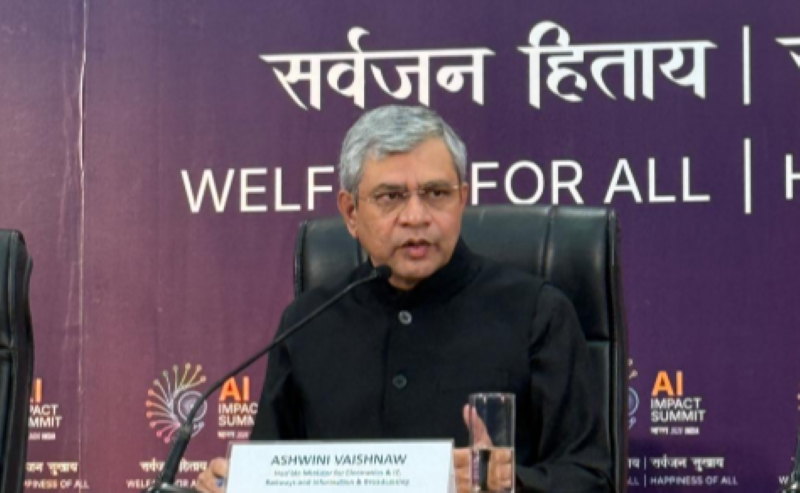
India to add 20,000 GPUs soon, scale AI compute capacity: Ashwini Vaishnaw
New Delhi/IBNS: Union Minister for Electronics & Information Technology, Ashwini Vaishnaw, has announced on the second day of the India AI Impact Summit 2026 that India will scale its compute capacity beyond the existing 38,000 GPUs with the addition of 20,000 GPUs in the coming weeks.
He highlighted that this marks the next phase of India’s AI strategy, with a significant expansion of compute infrastructure and a focus on responsible AI deployment.
Addressing the media at the Summit, the minister reiterated that the focus remains on responsible AI development and wider deployment across sectors such as healthcare and education to ensure that AI benefits all.
Vaishnaw emphasized that India’s AI strategy demonstrates Prime Minister’s Narendra Modi’s vision of democratizing technology.
Unlike many other countries where AI infrastructure is controlled by a few companies, India has provided AI compute access to a wide section of its population.
The interaction was attended by Jitin Prasada, Minister of State for Electronics & Information Technology and Commerce & Industry; S. Krishnan, Secretary, Ministry of Electronics and Information Technology; and Abhishek Singh, CEO, IndiaAI Mission.
The summit, being held from February 16-20 in New Delhi, has brought together Heads of State and Government, ministers, global technology leaders, researchers, multilateral institutions, industry stakeholders, startups, and students.
The minister also highlighted strong global participation in the Summit, with top executives conducting around 20 sessions and demonstrating commitment from global AI leaders.He acknowledged that the entire team is working day and night to organize what is being called the world’s biggest AI Summit.
Vaishnaw shared his optimism regarding the investment opportunity, stating that over the next two years, more than $200 billion worth of investment is likely to come.
He noted the commitment of venture capital firms to deep-tech startups and stated that investments are coming across all five layers of the AI stack. He added that venture capital firms and other players are committing funds for large solutions and major applications.
The minister stated that the IT industry is one of India’s biggest strengths and that every technology transition must be managed jointly by industry, academia, and government. Work is currently underway on three fronts: reskilling and upskilling the existing workforce, creating a new talent pipeline, and ensuring that future generations are prepared for emerging technologies. All three efforts are progressing in parallel.
Referring to energy capacity, the Minister noted that India is among the rare countries where more than 50 percent of power generation capacity comes from clean sources, currently about 51 percent, which provides a significant advantage for the country.
He further said that the Future Skills programme, launched three years ago, is now being deployed for AI-based reskilling. The Ministry of Education and AICTE are working on revising course curricula to ensure that the talent pipeline remains updated and that youth are equipped with new opportunities.
Regarding India’s sovereign AI models, the minister stated that several models launched at the Summit have been tested and measured against multiple parameters. When compared with global models, several Indian models have been rated better than many large international AI systems, underscoring India’s innovation capabilities. He also noted that Stanford has ranked India among the top three AI nations globally.
Acknowledging the potential misuse of AI, the IT minister highlighted the importance of a techno-legal approach to ensure AI is used for good while minimizing harmful impacts. This approach combines technological solutions with regulatory frameworks. He noted that India’s AI Safety Institute, a virtual institute working with multiple academic institutions, is developing technical solutions to prevent AI misuse.
On sectoral deployment, Vaishnaw described AI as driving the fifth industrial revolution, impacting every sector of the economy and society. He cited healthcare solutions showcased at the summit that can make healthcare more affordable and education solutions that enable tailored learning for every student.
Regarding chip development, the minister reaffirmed India’s commitment to the Semiconductor Mission, emphasizing that design will be the primary focus in Semiconductor 2.0. He projected that at least 50 deep-tech startups are expected to emerge from India in the coming years, driven by current innovation and development efforts.
Addressing sustainability, the minister highlighted investments in clean energy to power AI data centres and ongoing research to reduce power and water consumption. Emerging innovations indicate the potential to reduce AI infrastructure energy use by up to 35 percent.
The minister noted that on the first day of the summit, over 2.5 lakh students took a pledge to use AI for responsible innovation. The initiative is being submitted for recognition by Guinness World Records.
The minister concluded that India is committed to advancing AI responsibly, fostering innovation, and ensuring widespread deployment across sectors to benefit society at large.
Support Our Journalism
We cannot do without you.. your contribution supports unbiased journalism
IBNS is not driven by any ism- not wokeism, not racism, not skewed secularism, not hyper right-wing or left liberal ideals, nor by any hardline religious beliefs or hyper nationalism. We want to serve you good old objective news, as they are. We do not judge or preach. We let people decide for themselves. We only try to present factual and well-sourced news.
Support objective journalism for a small contribution.