 Educators
International Literacy Day: Celebrate educators, invest in learning potential
New York: With 1.4 billion people around the world lacking basic literacy skills, the head of the UN cultural agency on Tuesday urged all those involved in learning, to mobilize the investments needed that could unleash each person’s potential.
"At a time when we need to reinvent a world of hope, literacy is more important than ever,” said Audrey Azoulay, Director General of the United Nations Educational, Scientific and Cultural Organization (UNESCO), in her message for International Literacy Day.
Organized under the 2020 theme, “Literacy teaching and learning in the COVID-19 crisis and beyond”, the Day is celebrated annually on 8 September.
Educators a priority
This year’s commemoration highlights life-long literacy learning – keeping youth and adults at the centre of attention.
To overcome the epic impact of COVID-19, the first focus must be on frontline educators, stressed Ms. Azoulay.
“We have seen their dedication during this unprecedented situation,” she said, “but we have also witnessed their insecurity and deprivation, since the daily work of teaching literacy, however essential it is, receives too little recognition.”
Educators everywhere must be able to carry out their tasks in good working conditions, she continued, including by receiving fair pay and job stability. It also means empowering them through training throughout their practice so they can adapt in all circumstances, particularly school closures.
2 of every 3 students still out of school
With two out of every three students still unable to go back to school, the UN official underscored the importance of widespread training for educators in distance education solutions.
New technologies also hold big potential. While they cannot replace transmission of knowledge by humans, the UNESCO chief said they can nonetheless be valuable allies.
“We must support their development and make them accessible to all learners,” asserted Ms. Azoulay, calling it “an important aspect of our reflection on the Futures of Education.”
Policy gaps laid bare by pandemic
The COVID-19 crisis has been a stark reminder of the gap between policy discourse and reality – one that existed before the pandemic and only compounds the disadvantages faced by those who have no or low literacy skills.
During the pandemic, adult literacy programmes in many countries were left out of initial education response plans.
And most adult literacy programmes that did exist were suspended.
Literacy Day offers an opportunity to explore how to position youth and adult literacy learning in global and national responses, as well as formulate policies, systems and other measures to support educators.
The global celebrations featured a virtual meeting on the role of educators and changing pedagogies, and another online event celebrating the Laureates of the UNESCO International Literacy Prizes.
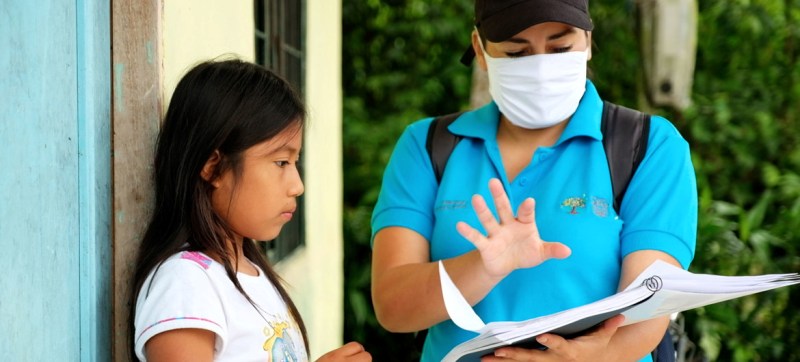
Photo credit and caption: UNICEF/Martin Kingman
An eleven-year-old girl in Ecuador receives a study guide during the COVID-19 pandemic when schools closed.
Support Our Journalism
We cannot do without you.. your contribution supports unbiased journalism
IBNS is not driven by any ism- not wokeism, not racism, not skewed secularism, not hyper right-wing or left liberal ideals, nor by any hardline religious beliefs or hyper nationalism. We want to serve you good old objective news, as they are. We do not judge or preach. We let people decide for themselves. We only try to present factual and well-sourced news.
Support objective journalism for a small contribution.