October 05, 2026 02:42 pm (IST)

Follow us:


Introduce your child early to the literary heritage of Bengali language
Kolkata, Feb 22 (IBNS) While Bengalis around the world observe Feb 21 as Bhasha Divas or Mother Language Day, it is also necessary to inculcate a love for the Bengali language among the younger generation was the opinion of many littérateurs and teachers of Kolkata.
Bhasha Divas harks back to Feb 21, 1952, when several students were killed in Dhaka when the police opened fire on protesters demanding the recognition of Bengali as one of the two official languages of East Pakistan (now Bangladesh).
The day became a global phenomenon when UNESCO proclaimed Feb 21 as the International Mother Language Day.
“But observing Mother Language Day is not an end in itself; we must inculcate a love for the language, especially among students,” remarked school teacher Kumkum Banerjee, who teaches Bengali in a Kolkata school.
According to many teachers, teaching Bengali—especially in urban settings—is becoming difficult as students are reluctant to study it as a language.
One of the best ways to instil a love for the Bengali language is to introduce students to the vast literary heritage of Bengali language.
So Banerjee usually takes her own school-going twins to Kolkata's book-stores.
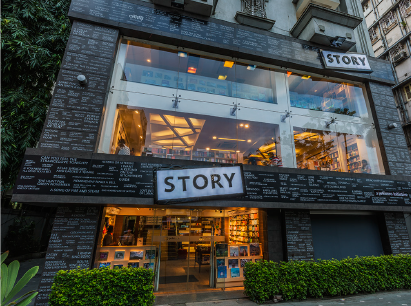
One of her favourite place is STORY on Elgin Road in south Kolkata.
This leading bookstore, which claims to be eastern India’s largest standalone book-store, covering an area of 15,000 sq feet, has four outlets in West Bengal—Elgin Road; Diamond Plaza Mall (Nager Bazar, north Kolkata); Avani River Side Mall (Howrah) and Junction Mall (Durgapur).
The Bengali section of STORY focuses on popular Bengali writers, both from the classical and the modern genres.
Rabindranath Tagore is an all-time favourite.
According to a store employee, Sunil Gangopadhyay and Sanjib Chattopadhyay are two of the most popular authors whose books have a brisk sale.
Other popular authors include Nabanita Dev Sen, Suchitra Bhattacharya, Satyajit Ray, Sharadindu Bandopadhyay, Shirshendu Mukhopadhyay and Buddhadev Guha.
The recent spurt in detective movies has also enthused young people to seek the authors’ other books, which is a good sign according to the store employee.
He also said that collected works sell well, especially for gifting.
STORY not only has a huge collection of Bengali books but also offers a separate corner where visitors can sit and browse through books.
Instead of forcing your children to buy a Bengali book, let them first browse through them, suggests Banerjee.
So, if you are fretting that your children do not read enough Bengali books, drop in at STORY.
The pleasant setting and the wide variety of books promise a good time—browsing books, reading them together, buying a book that both of you like.
You can conclude the trip to STORY by visiting the Bhasha Sahid Smarak, located at Deshapriya Park, not far from here, and an initiative of chief minister Mamata Banerjee, to pay respect to the students who laid down their lives in Dhaka to establish the rights of Bengali as a language.
Support Our Journalism
We cannot do without you.. your contribution supports unbiased journalism
IBNS is not driven by any ism- not wokeism, not racism, not skewed secularism, not hyper right-wing or left liberal ideals, nor by any hardline religious beliefs or hyper nationalism. We want to serve you good old objective news, as they are. We do not judge or preach. We let people decide for themselves. We only try to present factual and well-sourced news.
Support objective journalism for a small contribution.
Latest Headlines
‘We are the worst storytellers’: Suhel Seth on India’s failure to market itself at 'Kitaab' book launch
Mon, Sep 07 2026
Padma Shri Mukesh Batra launches ‘TOXIC’, explores overlooked forms of modern-day toxicity
Mon, Aug 24 2026
Padma Shri Mukesh Batra launches ‘TOXIC’, explores overlooked forms of modern-day toxicity
Mon, Aug 24 2026
As Taslima Nasreen returns to Kolkata, a look at her controversial books that changed her life journey
Sat, Aug 01 2026
Religion without servility: Journalist Anshul Chaturvedi on why Vivekananda speaks to believers and atheists alike
Sat, Jan 17 2026