 Kashmir University
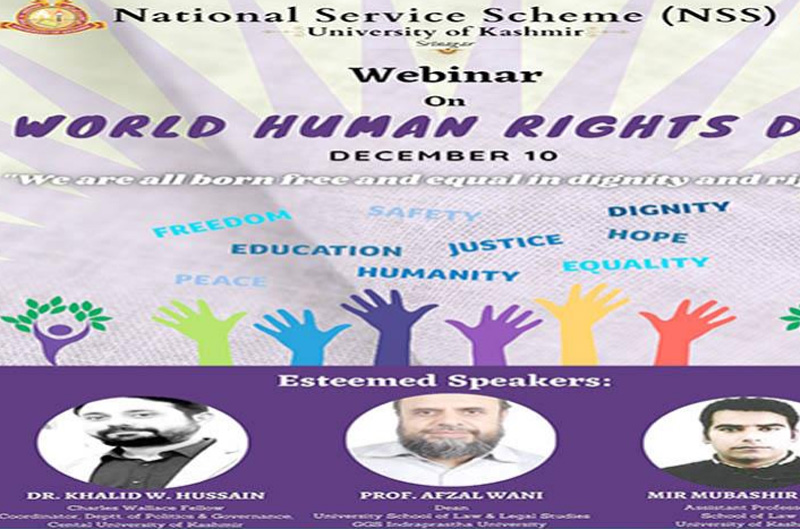
J&K: KU's NSS organises webinar to mark Human Rights Day
Srinagar: Academics and legal experts Friday called for raising levels of public awareness to ensure that human rights of marginalised sections of the society are protected with greater seriousness amid new challenges posed by the COVID19 pandemic.
They were addressing a webinar, organised by Kashmir University’s National Service Scheme (NSS), to mark the Human Rights Day, observed every year on December 10.
In his keynote address, Prof M Afzal Wani of the Guru Gobind Singh Indraprastha University Delhi said that respect for human rights was imperative to lay foundations of a peaceful society.
He suggested that district judges should be given the powers to entertain petitions under the constitution’s Article-32, which gives the right to individuals to move the Supreme Court if they feel their right to justice has been “unduly deprived”.
“This will ensure accessibility of weaker sections of the society to justice and make human rights more meaningful,” Wani said.
Coordinator, Department of Politics and Governance, Central University of Kashmir, Khalid Hassan critically evaluated the influence of western philosophical thought on human rights jurisprudence.
“The human rights discourse was essentially elitist in its approach and this was the primary reason for its failure to address the needs of the marginalised sections of the society,” he said.
Mir Mubashir Altaf from KU’s School of Law highlighted, from the constitutional law perspective the issue of women’s rights in the country.
He said that while the constitution provides a rights-based framework in this regard, reality on the ground is different. In his message for the webinar, Coordinator NSS Musavir Ahmad said COVID19 pandemic had posed new challenges vis-à-vis protection of human rights of marginalised sections of society.
He said this year’s theme for Human Rights Day ‘Recover Better Stand Up for Human Rights’ has been chosen accordingly to end discriminations, address inequalities and encourage solidarity for a better post-COVID19 world.
Organiser of the webinar Heena Basharat said COVID19 pandemic had demonstrated how greatly interconnected and interdependent the entire world was. “Therefore, respect for human rights has to be fostered universally,” she said.
Support Our Journalism
We cannot do without you.. your contribution supports unbiased journalism
IBNS is not driven by any ism- not wokeism, not racism, not skewed secularism, not hyper right-wing or left liberal ideals, nor by any hardline religious beliefs or hyper nationalism. We want to serve you good old objective news, as they are. We do not judge or preach. We let people decide for themselves. We only try to present factual and well-sourced news.
Support objective journalism for a small contribution.