 IGNCA
IGNCA
Recently released books by IGNCA uphold the age-old Indo-Japanese connection
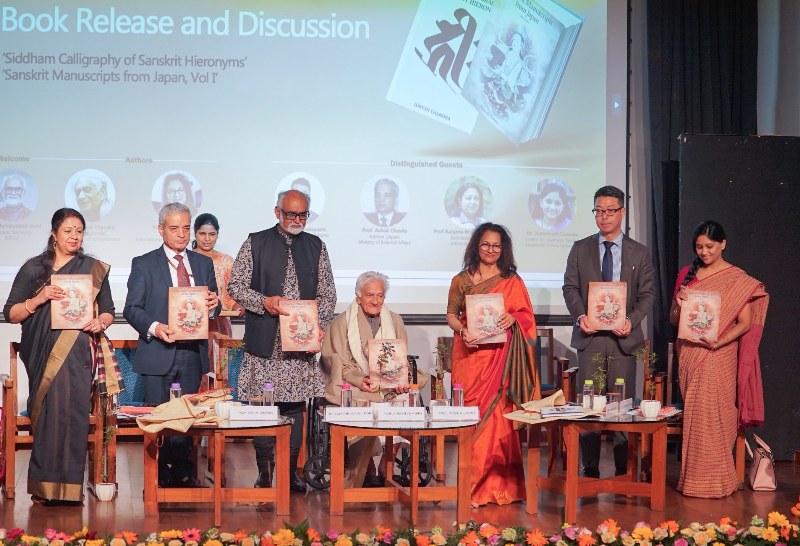
New Delhi/IBNS: Taking the Indo-Japanese bond a step further, Indira Gandhi National Centre for the Arts (IGNCA) released two books, ‘Siddham Calligraphy of Sanskrit Hieronyms’ and ‘Sanskrit Manuscripts from Japan, Vol I’, at a function recently held in New Delhi.
New Delhi/IBNS: Taking the Indo-Japanese bond a step further, Indira Gandhi National Centre for the Arts (IGNCA) released two books, ‘Siddham Calligraphy of Sanskrit Hieronyms’ and ‘Sanskrit Manuscripts from Japan, Vol I’, at a function recently held in New Delhi.
‘Siddham Calligraphy of Sanskrit Hieronyms’ is authored by Professor Lokesh Chandra, and ‘Sanskrit Manuscripts from Japan, Vol I’ is authored by Professor Nirmala Sharma.
The books were released by Sachchidanand Joshi, Member Secretary, IGNCA; Ashok Chawla, Advisor (Japan), Union Ministry of External Affairs; Ranjana Mukhopadhyay, University of Delhi; Takashi Kobayashi, First Secretary (PR & Culture), Japanese Embassy; and Janashruti Chandra, Jawaharlal Nehru University (JNU).
Both authors and the Venerable Khambo Lama of Mongolia were also present at the event.
Authored by Lokesh Chandra (98 years of age), an eminent scholar of Buddhism, ‘Siddham Calligraphy of Sanskrit Hieronyms’ is a comprehensive exploration of the history and evolution of Siddham calligraphy, according to a release from IGNCA.
It not only delves into the artistic intricacies of Siddham calligraphy but also illuminates its cultural significance in facilitating the exchange between India and Japan.
It discusses calligraphic styles, characteristics of Zen calligraphy, various dharinis, the calligram of Prajnakirti of Kashmir, and the culmination of Siddham calligraphy in its spontaneity and rapture by Kobo Daishi.
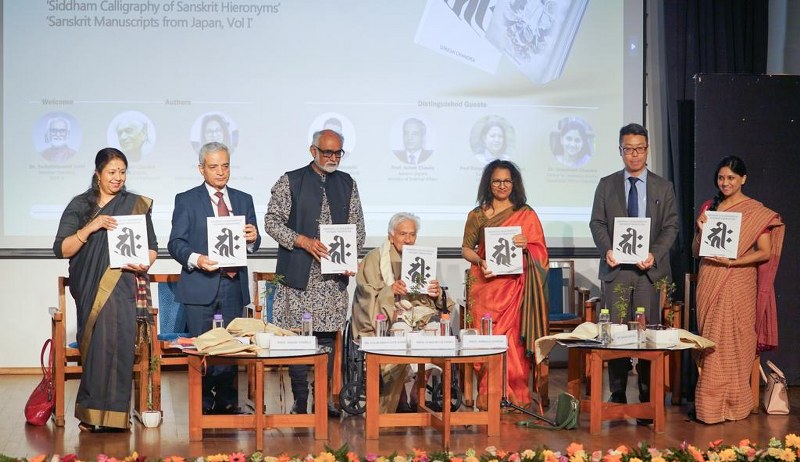
'Sanskrit Manuscripts from Japan, Vol. 1' marks the beginning of a series featuring facsimile editions of Sanskrit manuscripts from Japan.
It showcases 32 meticulously reproduced facsimiles from the collection of the Kokiji Monastery.
Prof. Sharma's meticulous curation allows readers to delve into the rich repository of Sanskrit manuscripts, thereby facilitating a deeper appreciation of Japan's invaluable contribution to the preservation of Sanskrit literature, the release said.
According to Lokesh Chandra, calligraphy is the heart of the [Japanese] nation, Siddham is a divine script and a living dynamism of the Mantrayana way of Dharma in Japan.
The first constitution of Japan (A.D. 604) was consecrated by a Sanskrit manuscript of the Usnisa-Vijay-Dharini, written in an earlier form of Siddham, he said.
Nirmala Sharma shared her experience of how the fascicules of the manuscripts had been gathered from the famous Kokiji monastery in Japan.
She also talked about Jiun Sonja of Japan, an 18th century saint, and his contribution to the collection of manuscripts.
According to Ashok Chawla, both books are an outcome of cumulative knowledge, gathered and matured over decades of hard work.
Ranjana Mukhopadyaya spoke about the close relations between India and Japan and how Buddhism travelled to Japan and left an indelible imprint.
Takashi Kobayashi expects both books will certainly redefine the relations between India and Japan, which are well-connected through Buddhism.
Janashruti Chandra said that both the books are well-researched and will complement the modules on Zen and Calligraphy as outlined in India’s National Education Policy.
Support Our Journalism
We cannot do without you.. your contribution supports unbiased journalism
IBNS is not driven by any ism- not wokeism, not racism, not skewed secularism, not hyper right-wing or left liberal ideals, nor by any hardline religious beliefs or hyper nationalism. We want to serve you good old objective news, as they are. We do not judge or preach. We let people decide for themselves. We only try to present factual and well-sourced news.
Support objective journalism for a small contribution.