 Sona College
Unique magnetic water treatment tech brings accolades to students of Sona College
Salem: Recognizing the importance of water in agriculture, a group of students has developed farm-friendly system that reduces water usage and minimizes dependency on fertilizer.
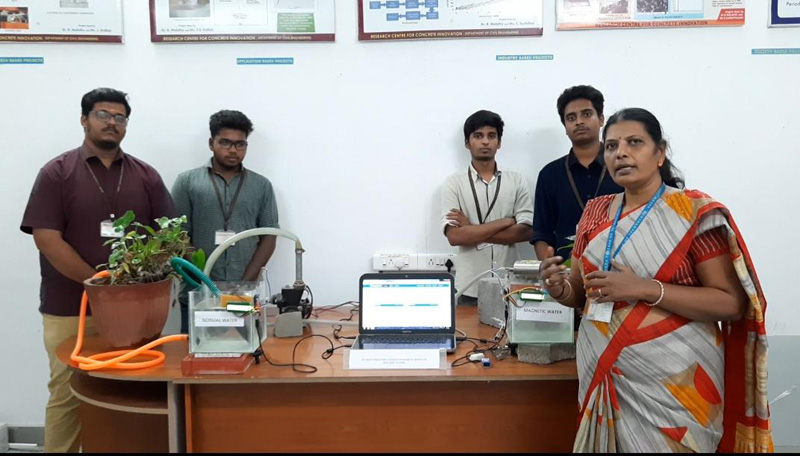
The team from Sona College of Technology, Salem, has secured first place in the Smart India Hackathon 2020, in the Hardware category, for their solution that uses the principles of Internet of Things (IoT) and magnetisation.
Of the 343 problem statements released for all participants, across 40 nodal centres, solutions from four teams from across India were recognised in the finals.
The team consisted of six students – Manimoliselvan C: Dinesh Kumar B, Manikandan S, Lokeshwar S, all pursuing final year Civil Engineering and Kungumaswetha A, final year, Computer Science Engineering and Suvetha S, final year (Electronics and Communications Engineering).
Dr R Malathy, Dean (R&D) and Professor, Department of Civil Engineering, Sona College of Technology, who mentored the team shared, “Our project aims to help farmers by purifying their available borewell water significantly, with zero waste.”
While borewell water is used for almost all farm applications, the nature of such water causes scaling. This in turn leads to non-uniform water supply to plants and poor mineral absorption. The limescale deposition also damages soil structure. Such hard water is absorbed by the plant cells with difficulty.
If through intervention, the water’s minerals are broken down into smaller particles, they become more bio-available to these plant cells.
Sona College’s solution achieves this by using a designated permanent rare earth magnet. The water is passed through a magnetic field and undergoes electrolysis and magnetisation. This breaks the larger water clusters into smaller, hexagonal-shaped clusters. Such magnetically treated, hexagonal-structured water molecules not only stop scaling, but also remove existing scaling.
The magnetic structuring breaks all minerals into smaller particles, and in the process, the salt in the soil is also broken down. As a result, the salt sinks deep into the soil and can be washed away easily. The desalinisation happens quickly over a season, creating much healthier plants and greater yields, and a better final product.
For even better effectiveness and easy monitoring, the inlet and outlet of the water pumping system developed by Sona College has been fitted with sensors that can measure water levels, weather and optical transducers to monitor nutrient absorption.
As per tests run by the team, the overall results in terms of plant growth proved to be dramatic. With minimal usage of water, the plants were hydrated well, were able to absorb maximum minerals. This resulted in greater yields, larger and better end product, earlier maturation, longer shelf life, and healthier plants.
Such a system allows a reduction in the water needs, as well as dependency on fertilizer and pesticides and can be a boon for farmers.
“This helps carry sufficient minerals in the standard composure, with water free from hardness for their transpiration and respiration, with zero maintenance cost. The IoT-enabled, user-friendly system makes our project unique,” said Dr Malathy.
“This solution was developed in around six months, starting with selection of the right magnet that can be used for borewell water at all places, visual observation on potted plants and then moving to a peanut field for research,” added Dr Malathy.
She shared that the team is also working on applying for a patent for their IoT-based solution.
Support Our Journalism
We cannot do without you.. your contribution supports unbiased journalism
IBNS is not driven by any ism- not wokeism, not racism, not skewed secularism, not hyper right-wing or left liberal ideals, nor by any hardline religious beliefs or hyper nationalism. We want to serve you good old objective news, as they are. We do not judge or preach. We let people decide for themselves. We only try to present factual and well-sourced news.
Support objective journalism for a small contribution.