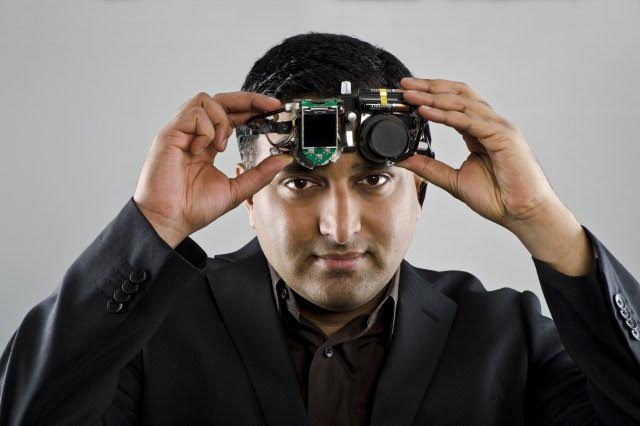
2016 Lemelson-MIT Prize winner Ramesh Raskar invents imaging system that can see around corners
Imaging scientist and social impact inventor Ramesh Raskar of MIT is a pioneer in the field of vision technologies, according to the MIT website.
Raskar is the co-inventor of radical imaging solutions including femtophotography, an ultra-fast imaging system that can see around corners; low-cost eye-care solutions for the developing world; and a camera that allows users to read pages of a book without opening the cover.
Raskar also uses invention and collaboration to respond to current and forward-looking needs in societies around the world through his Emerging Worlds initiative, MIT said in a release.
He seeks to catalyze change on a massive scale by launching platforms that empower inventors to create solutions to improve lives globally.
Raskar has mentored more than 100 students, visiting students, interns, and postdocs, who, with his guidance and support, have been able to kick-start their own highly successful careers.
“Raskar is a multi-faceted leader as an inventor, educator, change maker and exemplar connector,” said Stephanie Couch, executive director of the Lemelson-MIT Program. “In addition to creating his own remarkable inventions, he is working to connect communities and inventors all over the world to create positive change.”
The Lemelson-MIT Prize honors outstanding mid-career inventors improving the world through technological invention and demonstrating a commitment to mentorship in science, technology, engineering, and mathematics (STEM).
The prize is made possible through the support of The Lemelson Foundation.
Over the next three years, Raskar will be investing a portion of the prize money to support the development of young inventors.
“We are thrilled to honor Ramesh Raskar, whose breakthrough research is impacting how we see the world,” said Dorothy Lemelson, chair of The Lemelson Foundation. “Ramesh’s femtophotography work not only has the potential to transform industries ranging from internal medicine to transportation safety, it is also helping to inspire a new generation of inventors to tackle the biggest problems of our time.”
In 2012, Raskar co-created femtophotography, an advanced form of photography allowing cameras to see around corners.
The technology, currently in development for commercialization, uses ultrafast imaging to capture light at 1 trillion frames per second, allowing the camera to create slow motion videos of light in motion.
Raskar and his team have received significant funding from sponsors including the U.S. Defense Advanced Research Projects Agency (DARPA), the National Science Foundation, and MIT to further develop the idea of using "scattered light imaging" to see around corners.
Potential applications include avoiding car collisions at blind spots; detecting survivors in fire and rescue situations; and performing endoscopy and medical imaging to eliminate the need of an X-ray.
.
Image by Len Rubenstein/MIT website
Support Our Journalism
We cannot do without you.. your contribution supports unbiased journalism
IBNS is not driven by any ism- not wokeism, not racism, not skewed secularism, not hyper right-wing or left liberal ideals, nor by any hardline religious beliefs or hyper nationalism. We want to serve you good old objective news, as they are. We do not judge or preach. We let people decide for themselves. We only try to present factual and well-sourced news.
Support objective journalism for a small contribution.