 E20 Fuel
After Dharmendra Pradhan's exit, 'E20 Janta Party' emerges, demands Nitin Gadkari's resignation over fuel policy
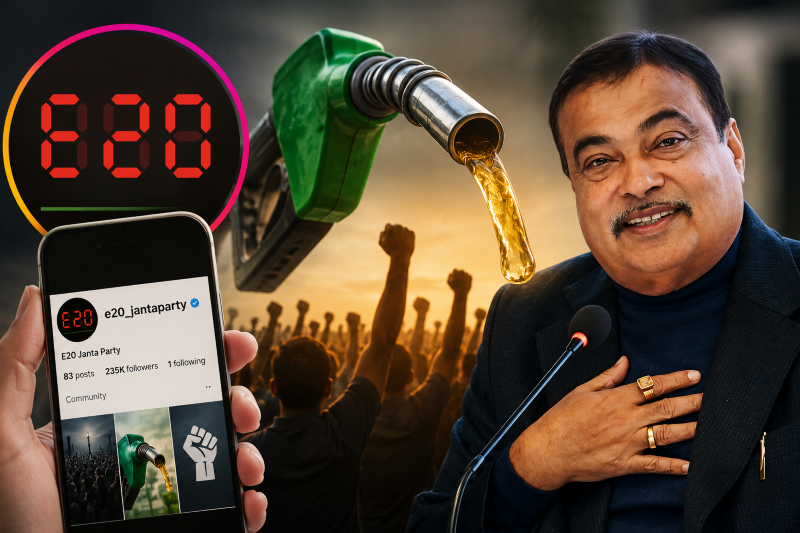
New Delhi/IBNS: A new Instagram community page titled 'E20 Janta Party' is rapidly gaining followers after the Cockroach Janta Party (CJP) movement forced Dharmendra Pradhan's resignation as Union Education Minister amid the nationwide NEET protests.
The page has already amassed over 235,000 followers, riding on the momentum created by the CJP campaign, where Instagram emerged as a key platform for mobilising support and keeping public pressure on the government.
The group has also launched an X (formerly Twitter) account under the same name, demanding accountability from Union Road Transport and Highways Minister Nitin Gadkari over the Centre's E20 fuel policy.
What is the group's demand?
The community is demanding the restoration of unblended petrol (100 percent petrol) at fuel stations, arguing that motorists should have the option to choose conventional fuel.
It has also called for Nitin Gadkari's resignation over the rollout of the E20 fuel policy.
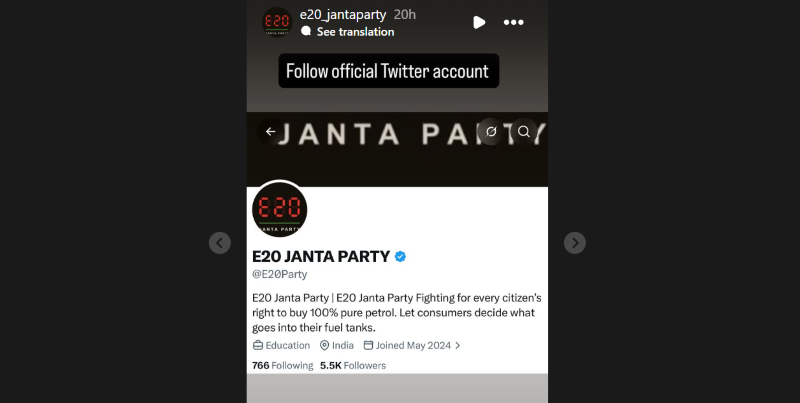 Photo: Screen-grab
What is E20 fuel?
E20 is a blend of 20 percent ethanol and 80 percent petrol. Ethanol is an alcohol primarily produced from sugarcane, maize and other agricultural feedstocks.
The Centre has promoted ethanol blending to:
- Reduce India's dependence on imported crude oil.
- Lower greenhouse gas emissions.
- Boost demand for agricultural produce and improve farmers' incomes.
- Strengthen the country's energy security.
Why is E20 fuel controversial?
1. Concerns over older vehicles
Critics say many petrol vehicles manufactured before E20-compatible engines became common were not designed to run on a 20 percent ethanol blend. They argue prolonged use could affect rubber hoses, fuel lines and other engine components, although the extent of the risk remains disputed.
2. Lower fuel efficiency
Since ethanol contains less energy than petrol, E20 generally delivers lower mileage than pure petrol. While the government and automobile industry maintain the drop is modest, many vehicle owners claim they have experienced a more noticeable decline in fuel efficiency.
3. Lack of fuel choice
A major criticism is that E20 has become the standard petrol available at most fuel stations, leaving owners of older vehicles with little or no option to purchase lower-ethanol or unblended petrol.
4. Pricing concerns
Critics also question why E20 is sold at prices similar to conventional petrol despite ethanol being cheaper, arguing consumers may end up paying the same amount for lower mileage.
What is the government's stand?
The Centre has defended the E20 programme, maintaining that:
- There is no verified evidence of widespread engine failures caused by E20.
- Most vehicles certified as E20-compatible operate safely on the fuel.
- Any reduction in fuel efficiency is limited.
- There are no immediate plans to increase ethanol blending beyond the current 20 percent.
The government has consistently argued that the programme is an important step towards reducing oil imports, cutting emissions and improving India's long-term energy security.
Support Our Journalism
We cannot do without you.. your contribution supports unbiased journalism
IBNS is not driven by any ism- not wokeism, not racism, not skewed secularism, not hyper right-wing or left liberal ideals, nor by any hardline religious beliefs or hyper nationalism. We want to serve you good old objective news, as they are. We do not judge or preach. We let people decide for themselves. We only try to present factual and well-sourced news.
Support objective journalism for a small contribution.