 India-Bangladesh
'Be careful with your words': Rajnath Singh’s caution to Yunus rattles Bangladesh
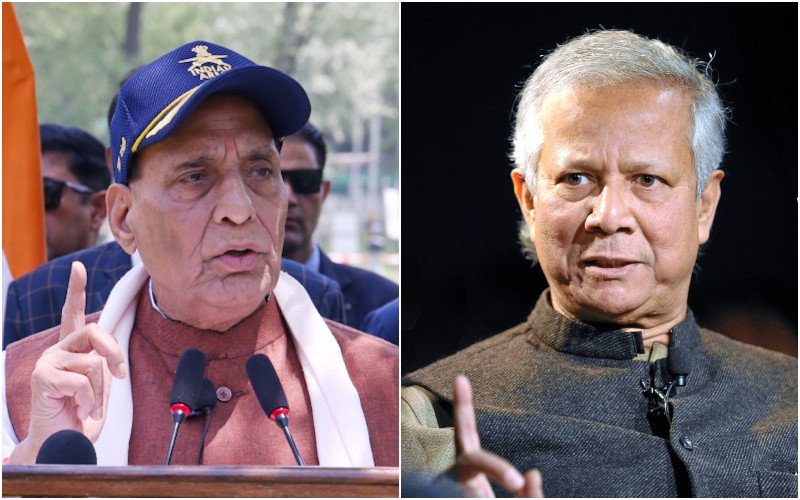
New Delhi/Dhaka/IBNS: Bangladesh has reacted strongly to Defence Minister Rajnath Singh’s recent remarks about its interim Chief Adviser Muhammad Yunus, calling them “incorrect” and “not in line with diplomatic propriety.”
The reaction came after Singh, in an exclusive interview with Network18 Group Editor-in-Chief Rahul Joshi, cautioned Yunus to be “careful with his words” following a series of provocative statements and symbolic gestures by the Bangladeshi leader.
The comments have created a stir in Dhaka, with the Ministry of Foreign Affairs issuing an official statement expressing disappointment over Singh’s words.
“We consider that Singh’s comments are incorrect, unhelpful, and not respectful of propriety and diplomatic nicety,” said SM Mahbubul Alam, spokesperson for the ministry.
He added that Bangladesh remains committed to maintaining “a mutually beneficial relationship with India based on sovereign equality, non-interference, and mutual respect.”
Rajnath Singh’s firm yet conciliatory tone
In his televised conversation, aired on Friday, Singh struck a balanced note, underlining that India does not wish to see strained ties with Bangladesh but expects its leadership to act responsibly.
“We do not seek tense relations with Bangladesh, but Yunus should be cautious with his statements,” Singh said.
He further noted that while India is capable of handling any challenge, New Delhi remains committed to maintaining peaceful and cooperative relations with its neighbours.
His remarks come at a time when the bilateral relationship—traditionally warm under former Prime Minister Sheikh Hasina—has entered a sensitive phase amid Bangladesh’s political transition.
Controversy surrounding Yunus’s actions
The current unease stems largely from Yunus’s recent provocative rhetoric and symbolic acts perceived as anti-India.
After taking over as interim chief adviser following Sheikh Hasina’s ouster, the Nobel laureate has made a series of statements and gestures that New Delhi views with concern.
One such act was Yunus’s presentation of a controversial artwork to Pakistan’s Joint Chiefs of Staff Committee (CJCSC) Chairman, General Sahir Shamshad Mirza, and a visiting Turkish parliamentary delegation.
The artwork—later identified as Art of Triumph—was reportedly a compilation of graffiti drawn by Bangladeshi youth during and after the August protests that led to Hasina’s fall.
However, according to News18, the artwork went beyond artistic expression, allegedly depicting a “Greater Bangladesh” plan that included India’s northeastern states—particularly Assam—within Dhaka’s envisioned sphere of influence.
Sources cited by the network suggested that the book contained “battle plans” and “post-victory management frameworks,” hinting at expansionist undertones.
“This was not an art display but a message — one directed at specific transnational Islamist networks that see Bangladesh’s interim regime as part of a wider strategic consolidation,” a source told News18.
Dhaka’s cautious defence of Yunus
While the Bangladesh Foreign Ministry stopped short of rejecting the reports about Yunus’s controversial gift, it focused instead on Singh’s remarks.
Spokesperson Alam reiterated that Dhaka continues to value its relationship with India and hopes that differences in perspective will be addressed through “constructive and respectful engagement.”
“Bangladesh believes that differences in perspectives are best addressed through dialogue and mutual understanding,” Alam said, urging both sides to uphold the spirit of cooperation that has long defined India-Bangladesh ties.
This measured response indicates that Dhaka wishes to de-escalate tensions without openly disavowing Yunus’s actions.
Observers believe that the government is walking a fine line between asserting its political autonomy and preserving crucial ties with India.
Strains in a historically strong partnership
The episode comes at a delicate juncture for both nations.
Under Sheikh Hasina, India and Bangladesh enjoyed unprecedented levels of strategic and economic cooperation, ranging from counterterrorism coordination to energy connectivity projects.
However, the political upheaval in Dhaka and Yunus’s rise to interim leadership have introduced new uncertainties.
New Delhi has been closely monitoring developments since the fall of Hasina’s government, particularly given Bangladesh’s geostrategic importance in the Bay of Bengal region and its role in India’s “Neighbourhood First” policy.
Analysts say Singh’s comments reflect New Delhi’s growing concern over Yunus’s perceived tilt toward anti-India narratives and his overtures to Pakistan and Turkey—two countries often critical of India’s policies in the region.
A test of diplomatic maturity
Despite the exchange of sharp words, both sides appear eager to avoid a full-blown diplomatic fallout.
Singh’s remarks, while firm, were balanced with reassurance that India does not seek confrontation, while Dhaka’s response, though critical, reaffirmed its commitment to bilateral cooperation.
This episode underscores the need for careful diplomacy as Bangladesh undergoes a political transition.
For India, maintaining stability and goodwill with Dhaka remains a strategic priority; for Bangladesh, preserving cordial ties with its largest neighbour is vital for its economic and regional ambitions.
Support Our Journalism
We cannot do without you.. your contribution supports unbiased journalism
IBNS is not driven by any ism- not wokeism, not racism, not skewed secularism, not hyper right-wing or left liberal ideals, nor by any hardline religious beliefs or hyper nationalism. We want to serve you good old objective news, as they are. We do not judge or preach. We let people decide for themselves. We only try to present factual and well-sourced news.
Support objective journalism for a small contribution.