 S Jaishankar
'Difficult phase after what China did on border': S Jaishankar on ties
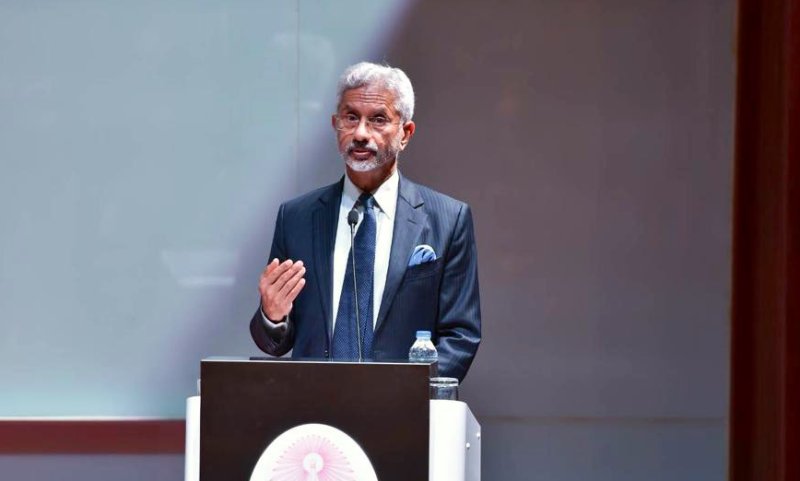
Bangkok/IBNS: External Affairs Minister S Jaishankar on Thursday said that the relationship between India and China is going through an "extremely difficult phase" after the prolonged standoff between the two countries at the border.
Jaishankar made the remarks while responding to a series of questions after delivering a lecture on 'India's Vision of the Indo-Pacific' at the prestigious Chulalongkorn University.
"At the moment (the India-China) relationship is going through an extremely difficult phase after what China did at the border," he said.
He said during this very period, the landscape also started to change as "we saw larger economic and political re-balancing."
"Just as India developed greater interests in the Pacific, countries of East Asia, for example have also been more visible in the Indian ocean. Even distant economies actually traverse the sea lanes from the Indian Ocean and Pacific Ocean as part of their supply chain commitments. The economic reality of globalization was that we are not merely more regional but actually much more active beyond our region in the search of markets and resources," he said.
This comes as Chinese and Indian troops are engaged in a prolonged standoff in Eastern Ladakh even as the two sides have so far held 16 rounds of Corps Commander Level talks to resolve the standoff which erupted on May 5, 2020, following a violent clash in the Pangong lake areas.
"I think if India and China have to come together, there are many reasons to do so, not necessarily only Sri Lanka," he said.
The political dimension of the Indo-Pacific has been equally strong but it has actually a very different logic. Simply put, the separation of the Pacific from the Indian ocean was a direct outcome of American strategic dominance since 1945.
"As the power distribution has diversified in the last two decades, changes were inevitable on this score as well. The re-positioning of the US, the rise of China as also of India, the greater external engagement of Japan and Australia, the wider interests of South Korea and indeed, the broader outlook of the ASEAN itself have all contributed to this transformation.
Some of it is also driven by our collective concerns for the global commons. It is no longer feasible for any one country to assume all the burdens," he said.
Support Our Journalism
We cannot do without you.. your contribution supports unbiased journalism
IBNS is not driven by any ism- not wokeism, not racism, not skewed secularism, not hyper right-wing or left liberal ideals, nor by any hardline religious beliefs or hyper nationalism. We want to serve you good old objective news, as they are. We do not judge or preach. We let people decide for themselves. We only try to present factual and well-sourced news.
Support objective journalism for a small contribution.