September 16, 2026 04:21 pm (IST)

Follow us:


Gender inequality is fundamentally a patriarchal power game: Survey
Kolkata, Mar 7 (IBNS): Almost 1900 women across the nation responded to questions to the online survey titled 'Is It an Unequal World?' and the findings clearly underlined that women felt they had a limited say in society.
They felt slighted and many believed that things may never change at least in the near future.
Conducted by two active online communities - WE (Women Endangered) and I Am Who I Am - the survey obtained responses from New Delhi, Mumbai, Kolkata, Bangalore, Jaipur, Hyderabad, Gurgaon and Pune, providing a representation from a mix of urban India.
When asked what they thought about society, over 50 per cent of women felt said that love had no place in society most of the time. Another 30 per cent were certain of the absence of love. They felt that norms that society encouraged had an over-riding power over love indicating that affection or the emotion of love was not important enough to society. In effect, to conform was what drove the world around them.
Interestingly, there were mixed views on their ability to influence society or to have a voice in what mattered in their lives. While one of the respondents claimed“all the Indian laws are formulated taking a man’s voice into account more than a woman”, a little over 50 per cent felt they have a voice and audience. Around 46 per cent believed their audience and ability to speak up was not regular.
The findings also suggested that not all forms of abuse against women got highlighted or talked about. 90 per cent of the respondents claimed this underlining the fact that only rape seemed to be the only form of abuse or assault against women.
“There are problems that are faced by women every day,” one respondent stated.
The survey findings observed that women could not blame one specific influence that has led them to be the lesser sex or gender in society.
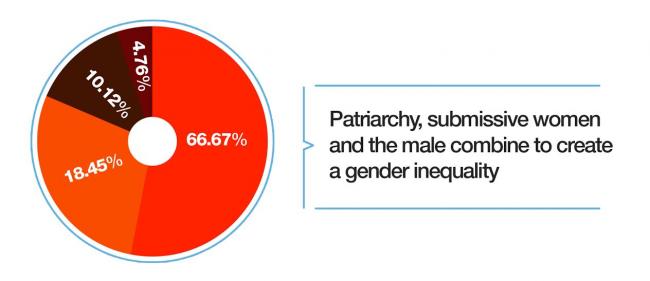
Over 60 per cent of the respondents felt it was a combination of patriarchy (at the lead), men and the submissiveness of women (10 per cent) that had led to their fate. Some of the respondents though did blame the inattentiveness of governments and the inability of society to change with the times for the situation women are in.
The survey conducted over six days between the end of February, 2015 and the beginning of March, 2015, polled as many as 1,892 women.
Support Our Journalism
We cannot do without you.. your contribution supports unbiased journalism
IBNS is not driven by any ism- not wokeism, not racism, not skewed secularism, not hyper right-wing or left liberal ideals, nor by any hardline religious beliefs or hyper nationalism. We want to serve you good old objective news, as they are. We do not judge or preach. We let people decide for themselves. We only try to present factual and well-sourced news.
Support objective journalism for a small contribution.
Latest Headlines
From President Murmu’s ADC to paid Instagram creator: Why Major Rishabh Singh Sambyal is facing criticism
Wed, Sep 16 2026
Gurugram biker crash: Main accused Kalyan Bainsla sent to police custody for 2 days
Wed, Sep 16 2026
Pak naval ship collides with Indian Navy unit in international waters; India takes action
Wed, Sep 16 2026
Jadavpur University tightens night entry: Students without legitimate reason after 8 PM to face action
Tue, Sep 15 2026
India flags 2 Pakistan-made fairness creams over excessive heavy metals; nationwide alert issued
Tue, Sep 15 2026
India dismisses Pakistan’s Masood Azhar bounty hike as ‘phoney announcement’, calls for concrete action
Tue, Sep 15 2026
Karnataka Congress chief calls Umar Khalid ‘nationalist’ amid NLSIU documentary row
Tue, Sep 15 2026