 S Jaishankar
'If we had been more Bharat, we would have had a less rosy view of our relationship with China': S Jaishankar
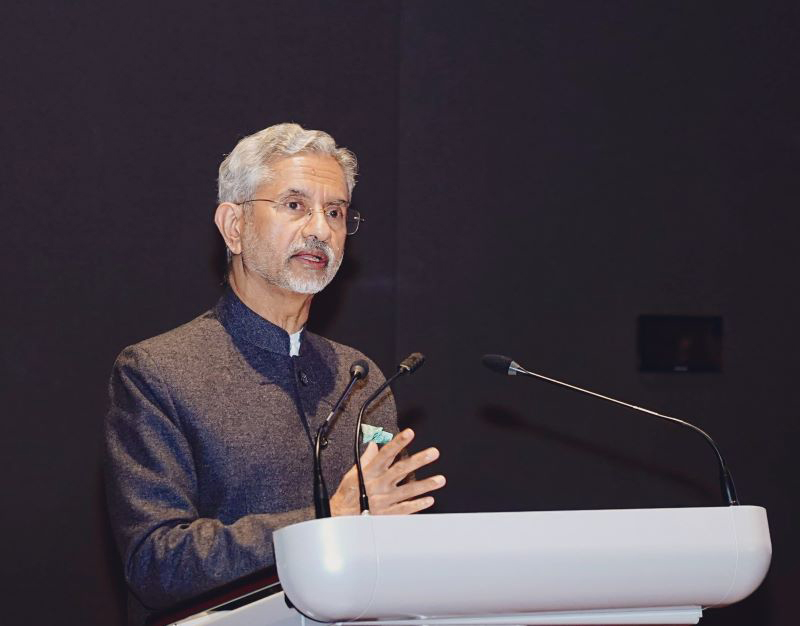
New Delhi/IBNS: External Affairs Minister S Jaishankar Wednesday reflected on India's relationship with China and provided a perspective on how a more Bharat-centric approach could have shaped the nation's view of its ties with China differently.
"If we had been more Bharat, we would have had a less rosy view of our relationship with China," said Jaishankar delving into India's historical perspectives on its relationships with China.
In an address at the launch event of his book 'Why Bharat Matters' in the national capital, Jaishankar said, "Regarding the three countries that I posited, Pakistan, China, and the US, were actually three very debated relationships in our early years."
Delighted to join my friend and colleague @PiyushGoyal ji today at Bharat Mandapam for the inauguration of #AtmanirbharBharatUtsav and #ODOP awards. #ODOP is a very unique and tangible expression of India’s diversity and its progress towards Atmanirbharata. Not only districts,… pic.twitter.com/7Gi4vT1lkP
— Dr. S. Jaishankar (@DrSJaishankar) January 3, 2024
The foreign minister referred to historical records, citing exchanges of notes and letters between the first Deputy Prime Minister and Home Minister of India, Sardar Vallabhbhai Patel and the first Prime Minister Pandit Jawaharlal Nehru on China.
He shared that the two leaders had starkly differing views about India's relationship with China.
"This is not something which is my fantasy. There is a kind of a record out there. There's an exchange of notes, letters between Sardar Patel and Pandit Nehru on China, and they have very starkly differing views about it," Jaishankar said.
Jaishankar highlighted Nehru's correspondence with Chief Ministers on the issue of China's place in the UN Security Council, emphasising that this historical context provided insights into the nuanced dynamics of India's diplomatic relations.
"If one looks at even the whole UN Security Council issue, this is not something which someone is saying today. There is a letter which Nehru has written to Chief Ministers saying, first let China take its place in the Security Council," Jaishankar said.
Even during the 1962 conflict, Jaishankar pointed out that Nehru sought assistance from the United States, acknowledging the hesitancy in seeking aid during a time when India was under attack.
"When the 1962 conflict war was taking place, Nehru actually wrote to Kennedy saying, 'Look, I need your help'...I'm not putting his exact words...but more or less 'I was hesitating to ask you because I was not sure how it would look overall when your country is actually under attack'," the External Affairs Minister also said.
The External Affairs Minister delved into the ideological landscape of that period, noting a strong left-wing influence in China and an ingrained hostility towards the United States.
"What happens is, in a sense there is a certain, I would say a kind of a left wing ideology which was very strong in that period, in China and similarly there's very ingrained hostility towards the United States the Americans did a lot to deserve it. But the fact is that the things which the Americans did we probably didn't deserve," he added.
Support Our Journalism
We cannot do without you.. your contribution supports unbiased journalism
IBNS is not driven by any ism- not wokeism, not racism, not skewed secularism, not hyper right-wing or left liberal ideals, nor by any hardline religious beliefs or hyper nationalism. We want to serve you good old objective news, as they are. We do not judge or preach. We let people decide for themselves. We only try to present factual and well-sourced news.
Support objective journalism for a small contribution.