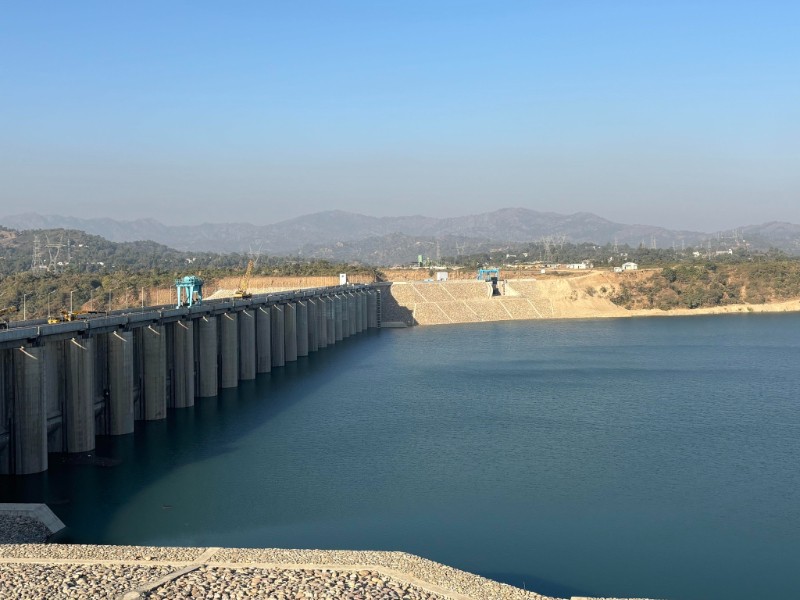
 Ravi River
India plans to cut Pakistan’s access to Ravi waters as Shahpur Kandi dam nears completion
New Delhi/IBNS: As summer approaches, Pakistan’s mounting water challenges could deepen further, with India preparing to halt the flow of surplus water from the Ravi River into Pakistan.
The move follows India's placing the Indus Waters Treaty in abeyance, a decision that has accelerated long-pending infrastructure projects on eastern rivers allocated to India.
Shahpur Kandi Dam nears completion
According to Jammu and Kashmir's Jal Shakti minister Javed Ahmed Rana, work on the Shahpur Kandi Dam on the Punjab–Jammu and Kashmir border is nearing completion.
Once operational, the dam will allow India to block excess Ravi waters that currently flow downstream into Pakistan, marking a significant shift in how eastern Indus basin rivers are utilised.
The minister said the project is expected to be completed by March 31, after which water will be diverted to the drought-prone Kathua and Samba districts.
Emphasising the project’s priority status, he said stopping surplus water flow to Pakistan was essential to meet domestic irrigation needs in the Kandi belt.
Redirecting water to drought-hit regions
At present, surplus Ravi waters pass through Madhopur into Pakistan, which lies downstream as the lower riparian.
Once the dam becomes functional, this water will instead be channelled into Punjab and Jammu and Kashmir, addressing long-standing irrigation shortages.
Officials say the project will irrigate around 5,000 hectares in Punjab and more than 32,000 hectares across Kathua and Samba districts.
Former irrigation minister Taj Mohideen has stated that the Indus Waters Treaty does not govern the dam’s operation, as India holds exclusive rights over the Ravi.
A project delayed for decades
The Shahpur Kandi Dam was first conceived in 1979 to stop the Ravi waters from flowing into Pakistan.
Former Prime Minister Indira Gandhi laid the foundation stone in 1982, but the project stalled for decades due to disputes between Punjab and Jammu and Kashmir.
It was finally declared a national project in 2008.
The dam is being built at a cost of Rs 3,394.49 crore, with Punjab contributing nearly 80 percent of the funds and the Centre covering the rest.
The structure stands 55.5 metres high and includes a 7.7-kilometre hydel channel.
Indus Waters Treaty put in abeyance
India’s water strategy hardened after April 23, 2025, when New Delhi formally placed the Indus Waters Treaty in abeyance, a day after a deadly terror attack in Pahalgam that killed 26 civilians.
For the first time since the treaty was signed in 1960, India explicitly linked water cooperation with Pakistan’s support for cross-border terrorism.
The decision coincided with Operation Sindoor and signalled a broader policy shift: cooperation, India said, cannot coexist with sustained hostility.
Strategic impact on Pakistan
Pakistan is heavily dependent on the Indus river system, with nearly 80–90 percent of its agriculture relying on these waters.
Its limited water storage capacity, estimated to cover barely a month’s flow, leaves it especially vulnerable to upstream developments.
With the treaty frozen, India has moved to accelerate multiple hydroelectric projects across the Indus basin, including Sawalkote, Ratle, Bursar, Pakal Dul, Kwar, Kiru, and Kirthai I and II.
Earlier this month, work on the Sawalkote project was also fast-tracked.
Support Our Journalism
We cannot do without you.. your contribution supports unbiased journalism
IBNS is not driven by any ism- not wokeism, not racism, not skewed secularism, not hyper right-wing or left liberal ideals, nor by any hardline religious beliefs or hyper nationalism. We want to serve you good old objective news, as they are. We do not judge or preach. We let people decide for themselves. We only try to present factual and well-sourced news.
Support objective journalism for a small contribution.