 Afghanistan Earthquake
India sends 21 tonnes of relief materials to earthquake-hit Afghanistan
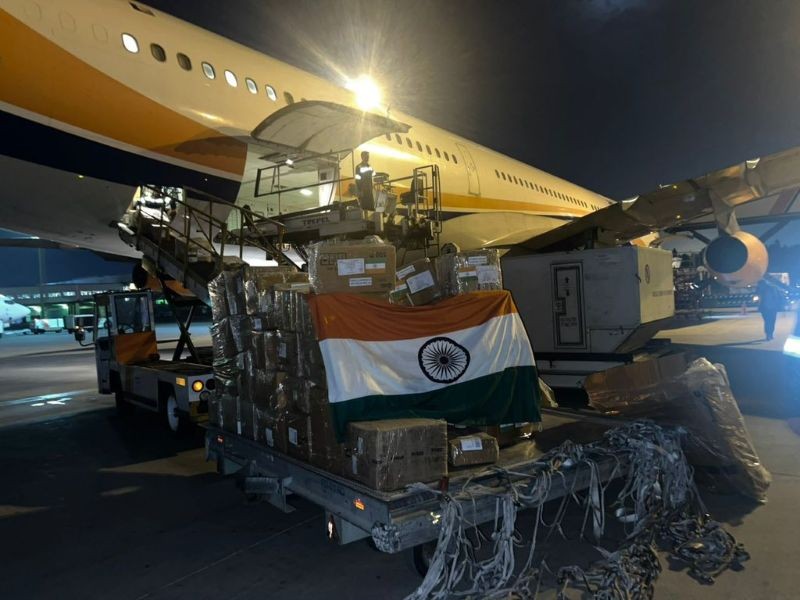
Indian External Affairs Minister S Jaishankar on Tuesday said New Delhi has sent 21 tonnes of relief materials to earthquake-hit Afghanistan and promised to send more aid to the nation in future.
More than 800 people died and at least 2,000 others were injured after a 6.0 magnitude quake hit the region on Sunday.
Indian earthquake assistance reaches Kabul by air.
— Dr. S. Jaishankar (@DrSJaishankar) September 2, 2025
21 tonnes of relief materials including blankets, tents, hygiene kits, water storage tanks, generators, kitchen utensils, portable water purifiers, sleeping bags, essential medicines, wheelchairs, hand sanitizers, water… pic.twitter.com/q8TUb1wbSn
S Jaishankar wrote on X: "Indian earthquake assistance reaches Kabul by air."
The relief materials include blankets, tents, hygiene kits, water storage tanks, generators, kitchen utensils, portable water purifiers, sleeping bags, essential medicines, wheelchairs, hand sanitizers, water purification tablets, ORS solutions and medical consumables.
The Indian Minister further said: " India will continue to monitor the ground situation and send more humanitarian aid over the coming days."
In remote eastern Afghanistan, aid workers are continuing to race to assist survivors of Sunday’s devastating earthquake as the death toll continues to climb, UN humanitarians said on Tuesday.
The magnitude six quake has already left more than 800 dead and at least 2,000 injured, but the total impact could be in the “hundreds of thousands”, according to the UN’s top aid official in the country, Indrika Ratwatte.
Speaking from Kabul, Ratwatte said that mud and wooden roof structures were predominant in the affected mountainous provinces.
“When the walls collapse, the roof is what basically falls on individuals, kills them or suffocates them,” he said. “Since this happened in the night, everybody was sleeping,” the senior UN aid official explained, indicating that many more people may be trapped under the debris.
Hundreds of thousands could be impacted, “as in houses destroyed, injured, casualties, livestock lost and any livelihood systems that they had”, Ratwatte explained.
In the first critical 24 hours after the earthquake hit, access was “very limited”, owing to landslides and rockfalls triggered by the tremors. Some roads were already blocked by previous rockslides caused by recent heavy rainfall.
“This has posed a huge challenge to us as we deploy right now,” Ratwatte said, stressing that 20 emergency assessment teams have been mobilized alongside 15 mobile teams “which will enhance the humanitarian flights from Kabul to Jalalabad”, capital of the affected Nangarhar province.
Afghanistan has long faced what the UN’s Humanitarian Coordinator Ratwatte called “systemic humanitarian challenges”.
Half of its population - or some 22.5 million people - need assistance, while food insecurity has been aggravated by recent drought.
Sweeping funding cuts to humanitarian programmes since the beginning of the year have meant that “hundreds” of aid facilities have had to close.
“The earthquake comes at a time where vulnerable communities are going to be super-exposed to additional stresses,” Ratwatte said.
Another major challenge is the return in 2025 of 2.4 million Afghan refugees from Iran and Pakistan, whom communities in the country have been “struggling to integrate”, said UN refugee agency (UNHCR) spokesperson Babar Baloch.
“More than half of these are deportations, people who have been put on buses and other forms of transport and left at the borders to go home, and it has already put a further restraint on our ability to support,” Baloch said.
Support Our Journalism
We cannot do without you.. your contribution supports unbiased journalism
IBNS is not driven by any ism- not wokeism, not racism, not skewed secularism, not hyper right-wing or left liberal ideals, nor by any hardline religious beliefs or hyper nationalism. We want to serve you good old objective news, as they are. We do not judge or preach. We let people decide for themselves. We only try to present factual and well-sourced news.
Support objective journalism for a small contribution.