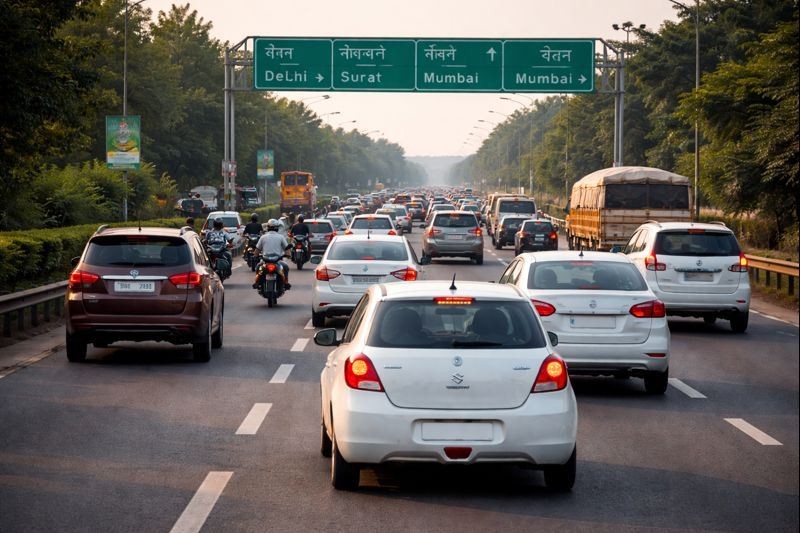
India to roll out vehicle-to-vehicle communication technology by 2026 to boost road safety
The Government of India is preparing to introduce Vehicle-to-Vehicle (V2V) communication technology nationwide by the end of 2026, a move aimed at significantly improving road safety and reducing accidents.
The system will enable vehicles to communicate directly with one another without relying on mobile networks.
By exchanging real-time signals, vehicles will be able to alert drivers when another vehicle comes dangerously close, helping prevent collisions.
Union Road Transport and Highways Minister Nitin Gadkari announced the initiative after the Annual Meeting with State Road Transport Ministers, saying the technology had been discussed in detail and would be implemented soon.
He noted that V2V communication would be particularly effective in preventing accidents involving parked vehicles that are often hit by fast-moving traffic from behind, as well as large-scale pileups during dense winter fog.
The technology is designed to function even in near-zero visibility conditions. Vehicles will receive alerts from all directions, providing 360-degree awareness of surrounding traffic, including stationary or roadside vehicles.
Officials said this feature would be especially useful during fog, when visibility between vehicles drops sharply.
According to the Ministry of Road Transport and Highways Secretary V Umashankar, the initiative marks a major step forward in road safety and is currently used in only a handful of countries globally. The overall project is estimated to cost around Rs 5,000 crore.
While consumers will bear some cost, the exact pricing has not yet been finalised.
The V2V system will operate through a device similar to a SIM card installed in vehicles.
It will work alongside Advanced Driver Assistance Systems (ADAS), aligning even premium vehicles that currently rely on sensor-based technologies with the new standard once it is officially notified.
Gadkari also stressed the importance of improving bus safety, highlighting that poor bus design has led to at least six major accidents resulting in 135 deaths.
He said existing buses will be retrofitted with additional safety features, including fire extinguishers, driver drowsiness detection systems and emergency hammers for passengers.
The Transport Ministry plans to notify the V2V technology by the end of 2026, followed by phased implementation across the country. Initially, the system will be installed in new vehicles, with wider adoption expected over time.
Officials believe the rollout of V2V communication will play a crucial role in reducing road accidents and enhancing overall traffic safety in India.
Support Our Journalism
We cannot do without you.. your contribution supports unbiased journalism
IBNS is not driven by any ism- not wokeism, not racism, not skewed secularism, not hyper right-wing or left liberal ideals, nor by any hardline religious beliefs or hyper nationalism. We want to serve you good old objective news, as they are. We do not judge or preach. We let people decide for themselves. We only try to present factual and well-sourced news.
Support objective journalism for a small contribution.