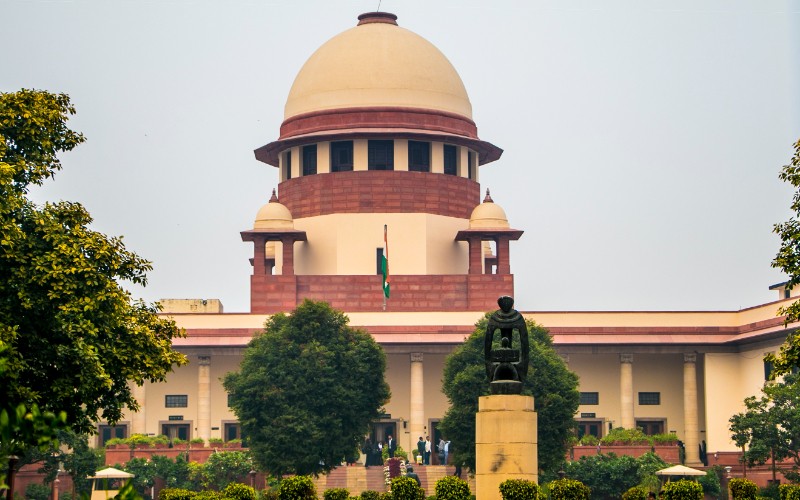
 UCC
UCC
'Most effective answer': Supreme Court says Uniform Civil Code key to ensuring equal rights for women
New Delhi/IBNS: India’s long-standing debate over the Uniform Civil Code has gained renewed attention after significant observations made by the Supreme Court during a recent hearing.
The court suggested that a common civil law framework may be necessary to ensure equal rights for women across communities.
The remarks came while the court was hearing a petition that alleged discrimination against Muslim women under existing inheritance provisions governed by personal law.
A three-judge bench comprising Chief Justice of India Surya Kant and Justices R. Mahadevan and Joymalya Bagchi discussed the broader implications of striking down religious personal laws without establishing a uniform alternative.
SC questions how personal laws can be replaced
During the hearing, the bench acknowledged that certain sections of Muslim society may face inequality in inheritance matters.
However, the judges also questioned what legal framework would replace the current system if Sharia-based inheritance provisions were invalidated.
The court observed that India has multiple social and legal asymmetries across different communities, including tribal groups.
It asked whether the judiciary could realistically eliminate such differences through judicial orders alone.
The bench also raised broader questions about marriage laws.
It pointed out that the constitutional goal of monogamous marriage has not yet been uniformly achieved across the country.
The judges asked whether the court could simply invalidate all polygamous marriages permitted under certain personal laws.
These questions highlighted the complexity of dealing with deeply rooted legal traditions linked to religion and community practices.
Court suggests legislative route for reform
Justice Joymalya Bagchi emphasised that removing personal laws through judicial intervention could create a serious legal vacuum.
He suggested that it would be more appropriate for Parliament to address the issue through legislation.
According to Justice Bagchi, if courts declare personal laws void without an alternative framework, uncertainty may arise in areas such as marriage, divorce and inheritance.
He remarked that such reforms should ideally come through legislative action, allowing the government to introduce a comprehensive Uniform Civil Code that applies equally to all citizens.
The bench indicated that courts must respect the constitutional role of the legislature in shaping policies that affect society at large.
Challenge to Muslim Personal Law provisions
The case before the Supreme Court challenges certain provisions of the Muslim Personal Law (Shariat) Application Act, 1937. The law governs aspects of marriage, divorce and succession among Muslims in India.
Petitioners argued that inheritance rules based on Sharia principles often provide women with a smaller share of property compared to male relatives.
Senior advocate Prashant Bhushan, representing the petitioners, suggested that if the 1937 law were declared unconstitutional, succession disputes could instead be governed by the Indian Succession Act, 1925. That law provides equal inheritance rights regardless of gender.
However, the bench questioned whether such a transition could occur smoothly without creating legal confusion.
Court warns against legal uncertainty
Chief Justice Surya Kant expressed concern that striking down the existing law without establishing a replacement framework might create uncertainty regarding inheritance and family matters.
The bench noted that current rights available to Muslim women under the existing law should not be undermined through sudden judicial intervention.
Justice Bagchi also pointed out that personal laws might continue to operate under Article 372 of the Constitution of India.
This provision allows laws that existed before the Constitution came into force to remain valid unless they are specifically repealed or amended.
As a result, simply declaring the Shariat-based law invalid may not automatically eliminate its legal effect.
Renewed focus on UCC debate
The court’s remarks have once again pushed the idea of a Uniform Civil Code into the national spotlight.
The concept of a UCC is mentioned in Article 44 of the Constitution of India, which encourages the state to work towards a common civil law for all citizens.
Such a code would govern matters such as marriage, divorce, inheritance and adoption regardless of religion.
Supporters believe a uniform framework would strengthen gender equality and ensure consistent legal standards across communities.
Critics, however, argue that any such reform must carefully balance constitutional principles with India’s cultural and religious diversity.
Support Our Journalism
We cannot do without you.. your contribution supports unbiased journalism
IBNS is not driven by any ism- not wokeism, not racism, not skewed secularism, not hyper right-wing or left liberal ideals, nor by any hardline religious beliefs or hyper nationalism. We want to serve you good old objective news, as they are. We do not judge or preach. We let people decide for themselves. We only try to present factual and well-sourced news.
Support objective journalism for a small contribution.