 Tamil Nadu
No Hindi, no NEET: Vijay reignites Tamil Nadu's biggest political flashpoints
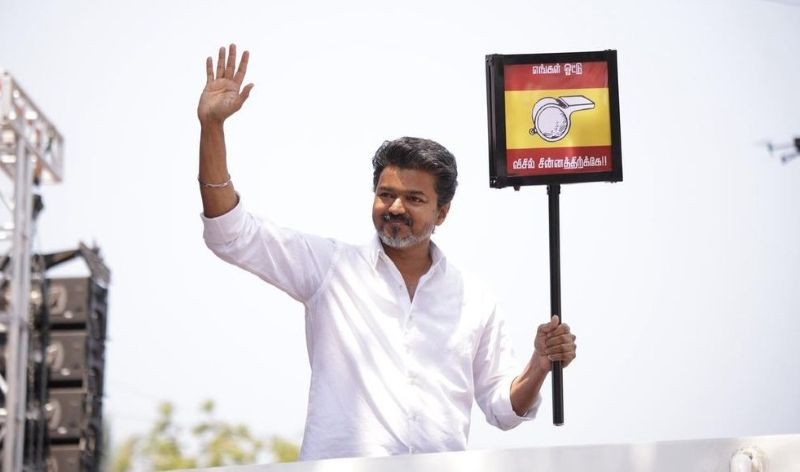
Chennai/IBNS: The Centre's three-language policy and the National Eligibility-cum-Entrance Test (NEET) came under sharp criticism from Tamil Nadu Chief Minister Joseph Vijay, who reiterated the state's long-standing opposition to both issues while defending Tamil and English as sufficient for the state's educational framework.
Addressing the Tamil Nadu Assembly, Vijay described NEET as an examination that "creates inequality" in the backdrop of the controversy surrounding alleged paper leaks and re-tests.
'NEET creates inequality'
The Chief Minister said the medical entrance examination had become a source of discrimination for aspiring students, particularly those from rural and economically weaker backgrounds.
His remarks echoed Tamil Nadu's long-standing demand for the abolition of NEET and a return to admissions based on Class 12 board examination marks.
Tamil Nadu sticks to two-language formula
Vijay also reaffirmed Tamil Nadu's opposition to the Centre's three-language policy, asserting that Tamil and English are sufficient for students in the state, ruling out the need for a third language in the school curriculum.
Tamil Nadu has repeatedly accused the BJP-led Centre of attempting to impose Hindi through educational policies, a charge consistently denied by the Union government.
Why Tamil Nadu opposes NEET
NEET was introduced as a common entrance examination for admission to undergraduate medical courses across India with the objective of ensuring a uniform and merit-based selection process.
However, Tamil Nadu has argued that the examination places students from the state board system at a disadvantage compared to candidates from CBSE and coaching-intensive backgrounds.
Successive governments in the state have maintained that NEET favours urban and affluent students who can afford expensive coaching centres.
The issue has also acquired an emotional dimension in Tamil Nadu following several reported cases of student suicides allegedly linked to exam-related stress.
The state Assembly has passed multiple resolutions seeking exemption from NEET, but these efforts have not received approval from the Centre.
The three-language policy debate
The three-language formula, first introduced in the National Policy on Education, broadly recommends that students learn three languages during their schooling years. In many states, this includes the regional language, Hindi and English.
Tamil Nadu, however, has followed a two-language policy for decades, teaching only Tamil and English in schools.
Tamil Nadu's two-language policy is rooted in the anti-Hindi agitations of the 1960s, which shaped the state's long-standing emphasis on protecting its linguistic and cultural identity.
The debate resurfaced after the implementation of the National Education Policy (NEP) 2020, with Tamil Nadu alleging that the policy could indirectly encourage Hindi imposition.
The Centre, on the other hand, has maintained that the policy does not mandate any specific language and gives states flexibility in implementation.
Political significance
Vijay's remarks assume significance as they come shortly after he assumed office as Chief Minister in May this year.
By taking a firm stand on NEET and the language issue, he has aligned himself with positions that have traditionally enjoyed broad political support across Tamil Nadu and remain key issues in the state's relationship with the Centre.
Support Our Journalism
We cannot do without you.. your contribution supports unbiased journalism
IBNS is not driven by any ism- not wokeism, not racism, not skewed secularism, not hyper right-wing or left liberal ideals, nor by any hardline religious beliefs or hyper nationalism. We want to serve you good old objective news, as they are. We do not judge or preach. We let people decide for themselves. We only try to present factual and well-sourced news.
Support objective journalism for a small contribution.