 Obesity
Obesity cannot be treated with shortcuts: Jitendra Singh
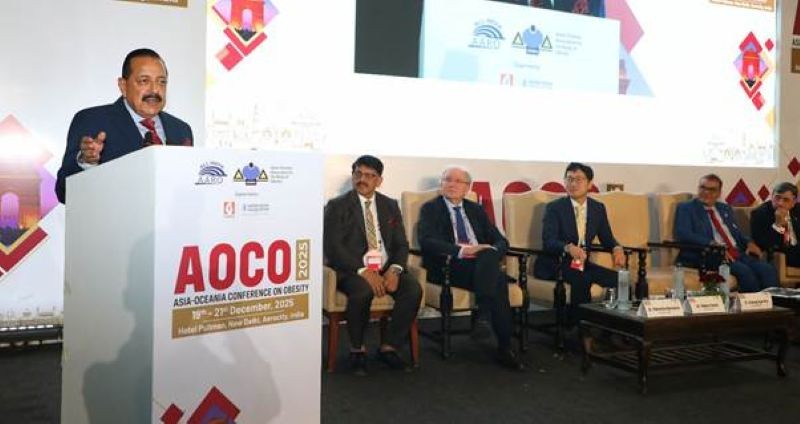
Union Minister of State (Independent Charge) for Science & Technology, Earth Sciences and MoS PMO, Personnel, Public Grievances, Pensions, Atomic Energy and Space, Jitendra Singh, on Sunday, said that weight-reducing or anti-obesity drugs, currently available, ought to be used very judiciously.
The Minister, who is himself a Diabetologist and Professor of Medicine, said that obesity is a complex, chronic and relapsing disorder, and not merely a cosmetic or lifestyle concern, calling for a whole-of-society approach to effectively combat what has emerged as one of India’s most pressing public health challenges.
Addressing the inaugural session of the 2-day "Asia Oceania Conference on Obesity" (AOCO), attended by some of the leading experts in the field including Dr Kyoung Kon Kim, Dr Volkan Yumuk, Dr Mahendra Narwaria, Dr B.M. Makkar, Dr Banshi Saboo and others, the Minister said the very fact that doctors, researchers, policymakers, and other stakeholders were coming together under one roof reflected the growing seriousness of the obesity epidemic in India.
Drawing an analogy, he remarked that just as economics is too serious a subject to be left to an economist alone, obesity is too serious a subject to be left to a physician or epidemiologist alone, as it has deep social, cultural, and environmental roots.
Dr Jitendra Singh highlighted that India is witnessing a worrying rise in Non-Communicable Diseases, which are linked to obesity in one way or another, and which account for nearly 63 per cent of overall mortality.
He pointed out that conditions such as type 2 diabetes, cardiovascular diseases and certain cancers are linked to obesity, including central or visceral obesity, which is particularly prevalent among Indians and poses independent health risks even beyond overall body weight.
Referring to the leadership of Narendra Modi, the Minister said it is unprecedented in the Indian context for a Prime Minister to repeatedly speak about obesity and lifestyle-related diseases from national platforms.
He highlighted that the Prime Minister’s emphasis on small, sustainable changes in food habits and daily routines reflects a clear recognition of obesity as a national priority, closely aligned with initiatives such as FIT India, Khelo India and the broader vision of preventive healthcare.
Dr Jitendra Singh said that since 2014, health has moved to the centre of national policymaking, with the government focusing on prevention, affordability, and early intervention. He cited Ayushman Bharat, mass screening programmes and India’s growing global leadership in preventive healthcare, including the development of indigenous vaccines, as examples of this shift.
He also highlighted the government’s emphasis on integrating traditional systems of medicine through a dedicated Ministry of AYUSH.
The Minister cautioned against the growing commercialization and misinformation surrounding obesity management, warning that unscientific claims and so-called quick-fix solutions often mislead people and distract them from evidence-based care. He stressed that formal approvals alone do not always tell the full story in clinical practice, recalling how the widespread adoption of refined oils in earlier decades led to unintended long-term health consequences.
Emphasising the need to protect public interest, he called for sustained efforts to counter myths and disinformation, particularly through the responsible use of modern media and digital platforms.
Emphasising the need to reach younger generations, Dr Jitendra Singh said public awareness must go beyond medical conferences and expert discussions. “We must talk not only to those who know, but also to those who do not know that they do not know,” he remarked, adding that safeguarding the health and energy of India’s youth is essential to realise the vision of a developed India by 2047.
During the event, the Minister also launched the AIAARO Obesity Registry, a significant initiative aimed at strengthening India’s obesity research ecosystem through systematic data collection, evidence-based insights, and long-term policy support.
The two-day Asia Oceania Conference on Obesity (AOCO) is the flagship conference of the Asia Oceania Association for the Study of Obesity (AOASO), a regional body representing obesity societies across Asia and Oceania.
In India, the conference is being organised by the All-India Association for Advancing Research in Obesity (AIAARO), the national obesity society and a member of AOASO, in association with AOASO and with the support of IAEPEN India and OSSI.
The conference aims to empower physicians, researchers, and policymakers by sharing global best practices, advancing research collaboration, and strengthening evidence-based management of obesity.
By bringing together national and international experts, AOCO seeks to address obesity not only as a medical condition, but as a societal challenge requiring coordinated action, sustained awareness, and informed public participation.
Support Our Journalism
We cannot do without you.. your contribution supports unbiased journalism
IBNS is not driven by any ism- not wokeism, not racism, not skewed secularism, not hyper right-wing or left liberal ideals, nor by any hardline religious beliefs or hyper nationalism. We want to serve you good old objective news, as they are. We do not judge or preach. We let people decide for themselves. We only try to present factual and well-sourced news.
Support objective journalism for a small contribution.