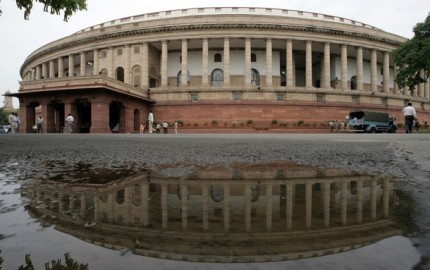
Rajya Sabha passes Judicial Appointment Bill
Now the judges would not be appointed only by a collegium of senior Supreme Court judges but by a panel of Commission of six members comprising the Chief Justice of India, the next two most senior judges of the Supreme Court, the Law Minister, and two eminent personalities, the last two to be selected by the Prime Minister and the Leader of Opposition.
While 177 members voted for the National Judicial Appointments Bill, three voted against it. 176 members voted in favour of the Constitution Amendment Bill.
After the government passed the bill in the lower house or Lok Sabha on Wednesday, the government in Rajya Sabha defended it even though there was first some noisy scenes over it as MPs demanded a discussion.
Union Finance Minister Arun Jaitley speaking on the Bill and amendment said the provision was that the President, which is the government, will appoint judges and will seek the advice of the Supreme Court and High Court.
He said the amendment will ensure transparency in appointment as he justified the decision of the government saying the spirit of the original Constitution will be restored. He assured that executive will not get primacy.
"The effort now is that we restore back the spirit of the original constitution - are we going to create executive primacy? the answer is no. Are we going to keep judicial primacy? the answer is yes," said Arun Jaitley.
Union Law Minister Ravi Shankar Prasad said should we not trust the collective wisdom of the head of the government (PM), the head of judiciary (Chief Justice of India) and the leader of Opposition in selecting eminent people in the Commission that will select the judges.
However, Chief Justice of India RM Lodha earlier endorsed the collegium system for appointing judges even as the government went on to pass the bill to overturn it.
"For God's sake don't shake the confidence of people in judiciary," Justice Lodha was quoted in media saying in connection with a petition on judge KL Manjunath whose promotion as Chief Justice of the Punjab and Haryana High Court has been challenged by the Centre.
"The collegium system has not failed. I am the person in the first batch appointed as a judge by the collegium system and Justice Rohinton (Nariman) is the last person. If the collegium system has failed then we are all failed," Justice Lodha said.
Several other judicial luminaries disapproved of the new system saying it will severely compromise the independence of judiciary.
Support Our Journalism
We cannot do without you.. your contribution supports unbiased journalism
IBNS is not driven by any ism- not wokeism, not racism, not skewed secularism, not hyper right-wing or left liberal ideals, nor by any hardline religious beliefs or hyper nationalism. We want to serve you good old objective news, as they are. We do not judge or preach. We let people decide for themselves. We only try to present factual and well-sourced news.