Supreme Court questions continued OBC reservation for children of affluent families
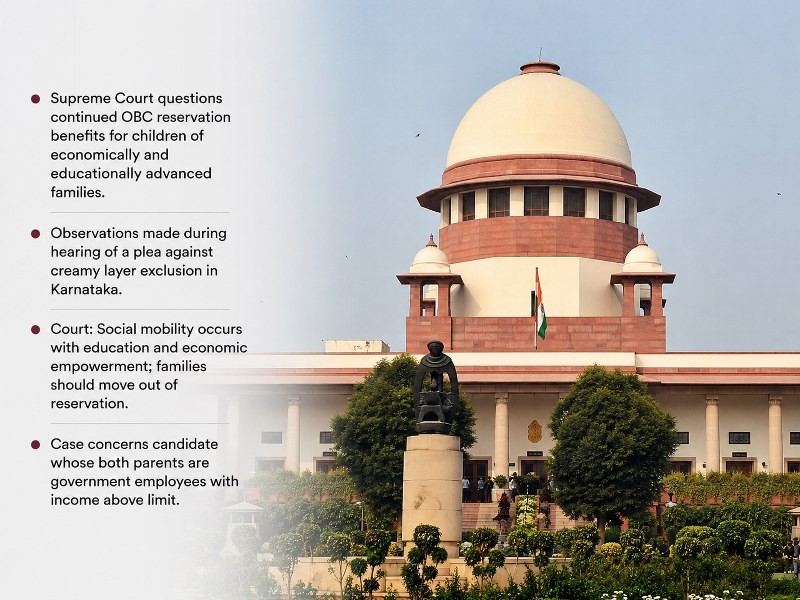
The Supreme Court on Friday questioned whether children of families that have already achieved social and economic advancement through reservation should continue receiving benefits under the Other Backward Classes (OBC) quota system.
Hearing a petition linked to creamy layer exclusion in Karnataka, the court observed that educational and economic progress often leads to social mobility as well, raising concerns about the continued extension of reservation benefits across generations.
'If both parents are IAS officers, why reservation?': Court
A bench of Justices BV Nagarathna and Ujjal Bhuyan made the observations during proceedings related to a candidate denied reservation benefits after being classified under the creamy layer category.
“If both parents are IAS officers, why should their children continue to get reservation? With education and economic empowerment comes social mobility,” Justice Nagarathna remarked.
She further observed that reservation was intended to uplift socially and educationally backward communities, but once families had progressed significantly, there had to be “some balance”.
“The parents have studied, they are in good jobs, earning good incomes, and the children still seek reservation. They should eventually move out of reservation,” the judge said.
Karnataka candidate challenged creamy layer exclusion
The case concerns a candidate from the Kuruba community, classified under Category II(A) among Karnataka’s backward classes, who had been selected as assistant engineer (electrical) in the Karnataka Power Transmission Corporation Ltd under the reserved category.
However, the District Caste and Income Verification Committee refused to issue him a caste validity certificate after determining that he belonged to the creamy layer.
Authorities noted that both his parents were government employees and that the family’s annual income was around Rs 19.48 lakh, exceeding the prescribed limit.
Debate over salary as creamy layer criterion
Appearing for the petitioner, advocate Shashank Ratnoo argued that salary income alone could not determine creamy layer status for government employees.
He submitted that creamy layer classification depends primarily on the service category of parents — such as whether they belong to Group A or Group B services — rather than their salary figures.
Ratnoo argued that if salary became the sole criterion, even lower-ranking government employees such as clerks, drivers and peons could lose reservation benefits.
He also contended that salary and agricultural income are traditionally excluded while calculating creamy layer status, and that only business or other additional income sources should be considered.
Court highlights social mobility through reservation
Justice Nagarathna repeatedly stressed during the hearing that reservation policies were designed to achieve upward mobility, and that families benefiting from reservations over generations posed a larger policy concern.
“There has to be a balance. Once parents have attained a level because of reservation benefits and are well placed in society, social mobility has happened,” she observed.
The court also noted the petitioner’s parents were drawing monthly basic salaries of Rs 53,900 and Rs 52,650, respectively.
Karnataka High Court verdict under challenge
The petition challenges a ruling by the Karnataka High Court, which had overturned an earlier single-judge order favouring the candidate.
The division bench had held that exclusion of salary income while determining creamy layer status applied only to reservations under the Union government and not to Karnataka’s state reservation framework.
Referring to Karnataka’s creamy layer policy, the High Court concluded that the candidate’s family income exceeded the permissible threshold, making him ineligible for reservation benefits under the OBC category.
Support Our Journalism
We cannot do without you.. your contribution supports unbiased journalism
IBNS is not driven by any ism- not wokeism, not racism, not skewed secularism, not hyper right-wing or left liberal ideals, nor by any hardline religious beliefs or hyper nationalism. We want to serve you good old objective news, as they are. We do not judge or preach. We let people decide for themselves. We only try to present factual and well-sourced news.
Support objective journalism for a small contribution.