 Muhammad Yunus
Trump’s return to White House is no music to ear for Bangladesh interim chief Muhammad Yunus backed by US Democrats
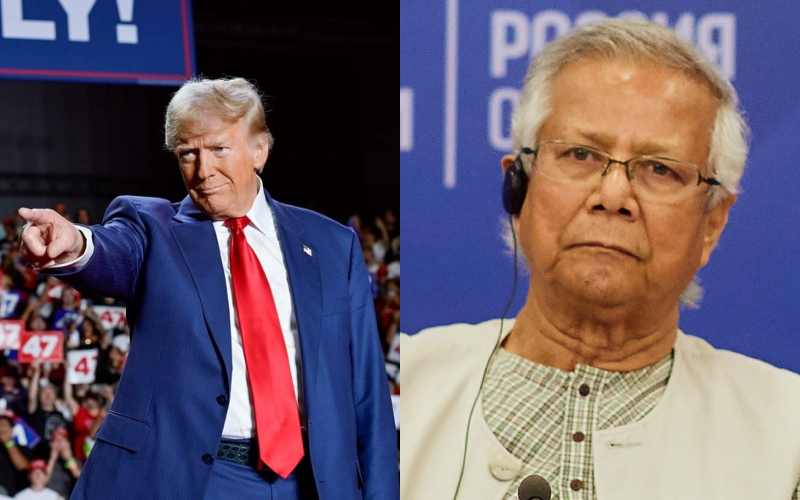
Donald Trump’s return to the United States presidency is stirring waves in Bangladeshi politics, with significant implications for Muhammad Yunus, the interim government’s Chief Adviser, who has long-standing ties with the cabal of US Democrats.
Trump’s outspoken condemnation of violence against Hindus and other religious minorities under Yunus’s administration adds a new layer of complexity, casting a shadow over the Bangladeshi Nobel Peace laureate's present leadership.
Meanwhile, ousted Prime Minister Sheikh Hasina, who is now living in exile in India, has extended a congratulatory message to Trump, a diplomatic move that suggests a strategic recalibration on her part.
Yunus, the Nobel laureate and microfinance pioneer, has historically enjoyed robust support from prominent Democrats like former Presidents Bill Clinton and Barack Obama, as well as strong advocacy from the Biden administration, which has championed Yunus's work in social enterprise and development.
Trump’s return, however, heralds a possible departure from this support, given his more transactional foreign policy approach and emphasis on security over humanitarian issues.
Trump’s criticism of the reported incidents involving religious minorities in Bangladesh could also signal a shift in US pressure on Yunus’s government to address domestic unrest more firmly.
Adding to this tense environment, Sheikh Hasina, Bangladesh’s ousted Prime Minister, took the opportunity to congratulate Trump.
Her message is seen by analysts as an astute political move, potentially signaling her openness to rekindling diplomatic ties with Washington under Trump’s leadership.
Hasina’s relationship with Trump during his first term was characterized by cautious engagement, but her congratulatory message now suggests she may be positioning herself to leverage US influence against the interim government and reclaim a degree of political influence.
Trump’s statement on violence against religious minorities in Bangladesh has drawn significant attention, as it places Yunus’s government under increased scrutiny.
Human rights groups have reported sporadic violence against minority communities in recent months, and Trump’s administration appears poised to address these issues as part of its renewed emphasis on protecting religious freedoms.
Trump's stance could create pressure on Yunus’s interim administration to take more decisive action on internal security and religious tolerance, potentially shifting focus away from Yunus’s traditional focus on poverty alleviation and social enterprise.
Yunus, who has championed microfinance and social development, may find it challenging to navigate this complex new dynamic.
His historically strong ties with Democrats have often shielded him from criticism, particularly regarding domestic issues.
But with Trump’s administration emphasizing religious freedom and minority rights, Yunus might need to adjust his priorities to align with the new US focus on security and stability, particularly if he hopes to retain American diplomatic support.
Observers suggest that this latest development could deepen existing tensions within Bangladesh.
Trump’s condemnation of religious violence aligns with his administration’s broader push for minority rights worldwide, a policy that could embolden Hasina’s political base.
Supporters of Hasina, who have previously criticized the interim government’s handling of domestic unrest, may seize upon Trump’s statement as a call for heightened accountability.
Geopolitics experts highlight that Trump’s stance on minority protection might put Yunus on the defensive.
Historically, his focus has been on development and poverty reduction, but Trump’s renewed focus on human rights and religious freedom could mean Yunus will have to adjust quickly to avoid further strain in US-Bangladesh relations, as per analysts.
The unfolding situation creates a complex scenario for Yunus, whose reputation has largely been built on his contributions to development and entrepreneurship rather than governance or security issues.
His administration may need to address these challenges head-on, with analysts suggesting that Yunus could be forced to take a harder line on maintaining communal harmony if he is to sustain support from the US and the international community.
With both Yunus and Hasina closely watching how US-Bangladesh relations evolve under Trump’s presidency, the coming months could see shifts in Bangladesh’s internal policies and international engagement, according to South Asia specialists.
As Hasina seeks to restore her influence and Trump keeps a close eye on minority rights, Yunus may face increasing pressure to strike a delicate balance between his legacy as a humanitarian and the demands of governance in a politically charged environment in Bangladesh, experts opined.
Support Our Journalism
We cannot do without you.. your contribution supports unbiased journalism
IBNS is not driven by any ism- not wokeism, not racism, not skewed secularism, not hyper right-wing or left liberal ideals, nor by any hardline religious beliefs or hyper nationalism. We want to serve you good old objective news, as they are. We do not judge or preach. We let people decide for themselves. We only try to present factual and well-sourced news.
Support objective journalism for a small contribution.