Kangana Ranaut accuses AR Rahman of prejudice after his 'communal' remarks on Bollywood
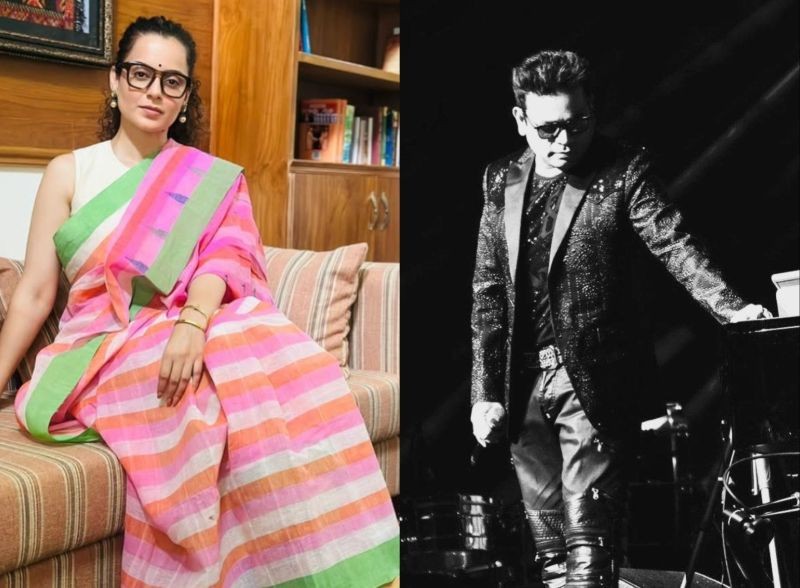
Actor-filmmaker Kangana Ranaut on Saturday accused Oscar-winning composer AR Rahman of being “prejudiced and hateful,” alleging that he refused to associate with her directorial film Emergency because he considered it a “propaganda film.”
In a strongly worded post on Instagram, Ranaut claimed that Rahman declined to even meet her when she wanted to narrate the film to him.
“I face immense prejudice and partiality in the film industry because of my political views, but I must say I have not come across anyone more prejudiced than you,” she wrote, alleging that she was informed Rahman did not want to be part of what he believed was propaganda.
Calling the refusal ironic, Ranaut said Emergency was widely praised by critics and even received appreciation from leaders of opposition parties.

“The film was called a masterpiece for its balanced and compassionate approach, but you are blinded by hate,” she added, concluding her post by expressing disappointment over the alleged treatment.
Ranaut’s remarks come amid a wider debate sparked by comments made by Rahman in a recent interview with the BBC Network, where the composer spoke about a decline in work from the Hindi film industry in recent years.
Rahman attributed the shift to changing power structures in Bollywood and suggested it may also be linked to “a communal thing.”
The composer said that such reasons are rarely communicated directly to him. “It comes to me as Chinese whispers,” Rahman said, explaining that projects sometimes move ahead with multiple composers despite his initial involvement.
He added that non-creative decision-makers increasingly influence hiring choices in the industry.
Rahman has not responded publicly to Ranaut’s allegations so far.
Several prominent voices from the Hindi film industry have disagreed with AR Rahman’s recent remarks suggesting that shifting power dynamics in Bollywood may have included a “communal” element, with writers, singers and lyricists asserting that the industry has largely remained merit-driven.
Author and columnist Shobhaa De described Rahman’s comment as “dangerous” and said she did not understand why such a claim was made.
Drawing on her five-decade-long association with Bollywood, De said she had not witnessed communal bias in the industry.
“If I have seen any place free of communal tension, it is Bollywood. If you have talent, you will get a chance. Religion has never been a factor,” she said, while adding that Rahman may have had personal reasons for making the remark.
Singer Shaan also dismissed the idea of communal or minority-based discrimination. Speaking to IANS, he said fluctuations in work are common and should not be interpreted through a political or religious lens.
“I have also been singing for many years and don’t get as much work as before, but I see it as a personal thing. How much work we get is not in our hands,” he said.
Veteran lyricist Javed Akhtar echoed similar views, saying he had never experienced or observed communal bias in the industry.
“People in Mumbai have immense respect for Rahman. He is such a big name that even small producers hesitate before approaching him,” Akhtar told IANS, adding that he did not believe there was any communal angle involved.
Support Our Journalism
We cannot do without you.. your contribution supports unbiased journalism
IBNS is not driven by any ism- not wokeism, not racism, not skewed secularism, not hyper right-wing or left liberal ideals, nor by any hardline religious beliefs or hyper nationalism. We want to serve you good old objective news, as they are. We do not judge or preach. We let people decide for themselves. We only try to present factual and well-sourced news.
Support objective journalism for a small contribution.