‘Crisis of multilateralism’ makes world’s ills appear ‘irresolvable’, German Foreign Minister tells UN Assembly
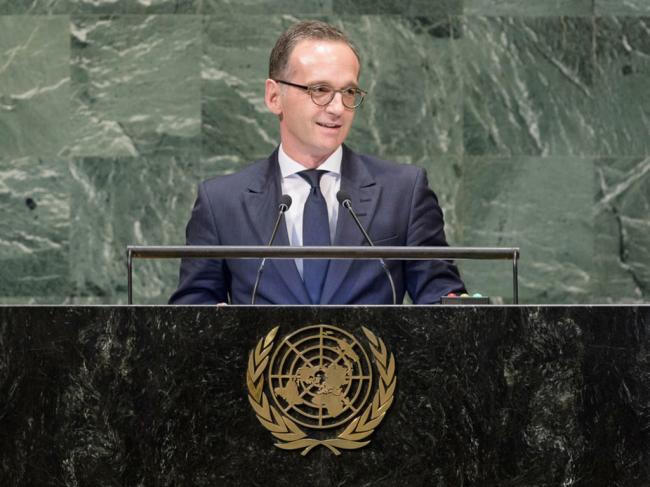
New York, Sept 29 (IBNS): Germany’s Minister for Foreign Affairs, Heiko Maas, outlined on Friday at the United Nations General Assembly a list of crises in the world, singling out “the crisis of multilateralism” as being at the root, frustrating solutions.
Citing Syria, the Democratic People’s Republic of Korea, the Middle East and the “dramatic” global refugee situation, Maas said “these disparate conflicts reveal a bigger picture and a distinct pattern,” namely the crisis of multilateralism, which “makes conflicts around the world appear irresolvable.”
Maas said he used the word “appear,” to reflect “the faith we Germans have in multilateralism,” calling his country’s post-World War II story “a triumph of multilateralism.”
“Europe has proved to the world that multilateralism and sovereignty are not a contradiction in terms,” he stated.
He drove home the value of countries working together by spotlighting Syria, where “nowhere is the crisis of multilateralism more painfully evident.”
Underscoring that the civil war had become a widespread regional conflict, with potentially further escalation in the already-ravaged region, he highlighted as “a glimmer of hope,” the diplomatic efforts that stemmed an escalation in Idlib.
“As the second-largest humanitarian donor, Germany is willing to provide UNHCR [the Office of the UN High Commissioner for Refugees] with a further 116 million euros…to help Syrian refugees in Jordan and Lebanon,” announced the Foreign Minister, adding: “But others also need to step up.”
Noting that sovereignty can only be safeguarded “if we work together,” he spoke about the need to reform the Security Council to be more representative and inclusive.
“The world’s population has more than tripled since 1945, while the number of UN Member States has almost quadrupled,” he highlighted. “However, the Security Council has hardly changed at all.”
Maas also noted that the UN of the 21st century must tackle root causes of conflict, which “include climate change.”
“Action based solely on nationalism, with the objective of ‘putting my country first’, reaches its limits here – not least because our climate knows no borders,” he asserted.
Signaling that Germany and the European Union stand by the Paris climate agreement, he indicated his that the Security Council should paye more heed to “the devastating effects that climate change can have on the security and stability of entire countries and regions.”
Calling the 2030 Agenda for Sustainable Development “our guiding principle” for making a better world for all people, he reflected on the Global Compact for Migration negotiations.
He applauded the fact that more than 190 Member States reached agreement “on such complex and controversial issues” as “a victory for multilateralism.”
“The UN is built on our courage to reach compromises,” he maintained, saying that common ground is created when we put people at the heart of what we do.
“The desire for peace and security, and the dream of a prosperous and dignified life, are things that all people share – whether they live in Baghdad, Berlin or Bamako,” concluded the Foreign Minister.
Support Our Journalism
We cannot do without you.. your contribution supports unbiased journalism
IBNS is not driven by any ism- not wokeism, not racism, not skewed secularism, not hyper right-wing or left liberal ideals, nor by any hardline religious beliefs or hyper nationalism. We want to serve you good old objective news, as they are. We do not judge or preach. We let people decide for themselves. We only try to present factual and well-sourced news.
Support objective journalism for a small contribution.