Casualties from cluster munitions double in 2016; Syrians most-affected – UN-backed report
The annual monitoring report released yesterday at the UN Office at Geneva by the Cluster Munition Coalition revealed that the use of cluster munitions in war-torn Syria and Yemen has caused even more civilian casualties. Moreover, in those two countries, conflict and insecurity are hampering clearance of the deadly weapons.
Of nearly 1,000 victims identified in 10 countries, almost all were from Syria, according to the Cluster Munition Monitor 2017.
“The humanitarian devastation caused by cluster munitions is particularly acute in Syria, where use has continued unabated since mid-2012,” the report's main editor and coordinator of the Landmine and Cluster Munition Monitor initiative Jeff Abramson told journalists in Geneva, warning that the real figure is therefore much higher.
Fellow report editor Loren Persi explained: “The vast majority of those casualties occurred in Syria and mostly during attacks, there was really unrelenting use of cluster munitions in Syria and Syria has been the reason for the majority of cluster munition casualties since 2013, definitely. Actually in 2016, almost 90 per cent of the casualties occurred in Syria.”
Abramson stressed that the only sure way to end this insidious menace “is to have all States embrace and adhere to the international ban on these weapons.”
The threat from cluster munitions is rarely short-lived, according to the report, which records casualties in places where the weapons have not been used for decades.
More than 100 people were known to have been killed or injured by previously unexploded cluster munition submunitions, the deadly landmine-like remnants left over from earlier attacks, including in South-East Asian countries such as Lao People's Democratic Republic. There, all of the 51 new casualties in 2016 were the result of remnants from cluster munitions used in the 1960s and 1970s.
Number of casualties in 2016 more than double the previously recorded high
Overall, the report identified at least 971 new cluster munition casualties globally in 2016, with 860 of these in Syria. This global number is certainly less than the actual total. Disturbingly, the number of casualties in 2016 is more than double the number recorded in 2015 (417), making it the second-highest annual figure since Cluster Munition Monitor reporting began in 2009 (the highest was in 2013).
Since August 2016, two countries have ratified the Convention on Cluster Munitions (Benin and Madagascar), bringing the total number of States Parties to 102. Another 17 States have signed but not yet ratified the convention. Last December, 141 states, including 32 non-signatories to the convention, adopted a key UN General Assembly resolution supporting the Convention on Cluster Munitions.
“Efforts to grow the Convention's membership continue to be central to stigmatize the use of these weapons and to bring an end to the threat they pose. Convention members have a better understanding of the location and scale of contamination, and will more readily share information about it, compared with states outside the convention,” said Amelie Chayer, acting Director of the Cluster Munition Coalition.
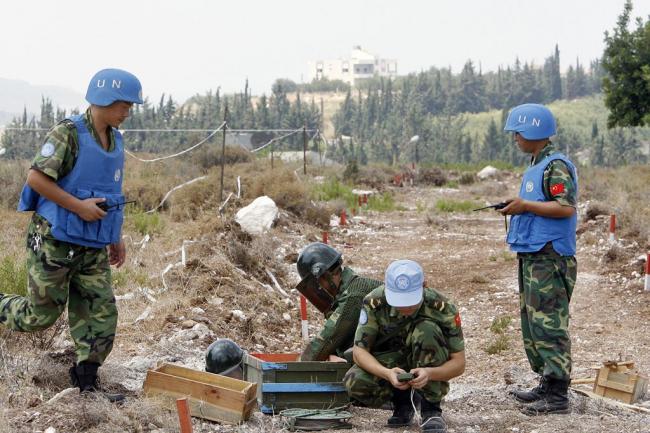
UN Photo/Mark Garten (file)
Source: www.justearthnews.com
Support Our Journalism
We cannot do without you.. your contribution supports unbiased journalism
IBNS is not driven by any ism- not wokeism, not racism, not skewed secularism, not hyper right-wing or left liberal ideals, nor by any hardline religious beliefs or hyper nationalism. We want to serve you good old objective news, as they are. We do not judge or preach. We let people decide for themselves. We only try to present factual and well-sourced news.
Support objective journalism for a small contribution.