 Libya
Libya
Delivering justice for Libya not ‘Mission Impossible’, Security Council hears
New York: Addressing the Security Council from Libyan soil for the first time ever, the International Criminal Court (ICC) prosecutor acknowledged that while challenges abound, justice for the Libyan people is not “Mission Impossible”.
“If we are willing to forge new partnerships…look at new ways of working together…[and] coalesce around human values…we can do much better in delivering justice for the people of Libya and hopefully that will assist in a wider hope for sustainable peace”, ICC Prosecutor Karim Khan told the ambassadors via video link.
Recounting his experiences over the last few days, he stressed that “we need to do better” and be more relevant.
Mr. Khan explained that he’d seen victims from all parts of Libya, from Benghazi to Derna, including detention victims from the Jura, Musoke and Chimera.
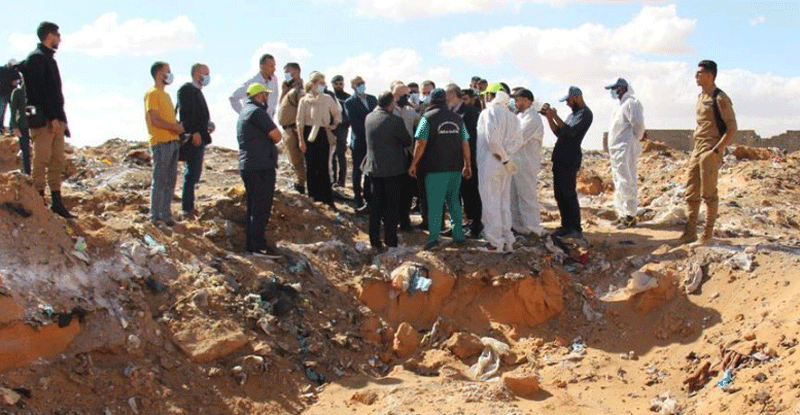
Tarhunah landfill
He recalled a two-hour drive out of Tripoli, to a place called Tarhunah where people live in inhumane conditions and spoke of “poor souls who were executed” and farms “that became mass graves”.
Along with deep fears, dead dogs and goats made it an “extremely difficult technical task” to clear away mounds of rubbish to find bodies “that had been thrown in as a result, it seems, of crimes within the court's jurisdiction”.
While applauding the courageous work of Libyan forensic experts, the ICC prosecutor noted that although 250 bodies have been recovered to date, far fewer have been identified.
Being relevant
At a different location, he spoke to other victims and survivors, including one man who lost 24 family members, and another 15.
A mother gave a dignified but compelling account of what she had witnessed in “the type of heartbreak” that only a survivor can tell.
Echoing long-held feelings concerning what the international community is doing and when the ICC will deliver justice, Mr. Khan said, “there is fatigue in Libya”.
Noting that 2011 “is long time ago”, he acknowledged that “we need to make sure that we are seen to be relevant”.
Partnerships pay-off
There is fatigue in Libya – ICC Prosecutor
Victims want the truth, they want their voices to be heard, and they want allegations to be determined by independent and impartial judges, the ICC prosecutor upheld.
And he argued against allowing the sentiment that impunity is inevitable to become pervasive.
Mr. Kahn said that good progress has been made on transparency and measurable objectives because of the partnerships being built.
“For the first time since 2011, I can report a regular presence by the staff of my office in the region. In the last reporting period…there's been 20 missions to six countries in which a variety of evidentiary material has been collected”, said Mr. Khan.
He said that partnerships have already begun paying dividends, detailing that last month, the Joint Investigative Team allowed the transfer of three individuals from Ethiopia to the domestic courts in Italy and the Netherlands.
“This shows the consistency…[that] the International Criminal Court is not an apex court. It is a hub and we need to work together to make sure there is less space for impunity and greater efforts. Accountability”, spelled out the ICC prosecutor.
Moving forward
“Libya is a key stakeholder. We are in Libya. This country is owned by Libya. The overwhelming crimes are against Libyans. And this partnership that we're trying to refocus and build, and foster is absolutely pivotal if we're to move things forward”, continued the ICC justice.
While acknowledging that “cooperation is not perfect”, he believed that collectively, “we can move things forward”.
“It's really not about power. It's not about the powerful”, underscored Mr. Khan.
It is about those who want the very basics, to live in peace, and when they've suffered loss, to know what happened.
They also need “a modicum of justice” – not as a value or idea, but rather “felt by the Libyan people”.
Support Our Journalism
We cannot do without you.. your contribution supports unbiased journalism
IBNS is not driven by any ism- not wokeism, not racism, not skewed secularism, not hyper right-wing or left liberal ideals, nor by any hardline religious beliefs or hyper nationalism. We want to serve you good old objective news, as they are. We do not judge or preach. We let people decide for themselves. We only try to present factual and well-sourced news.
Support objective journalism for a small contribution.