


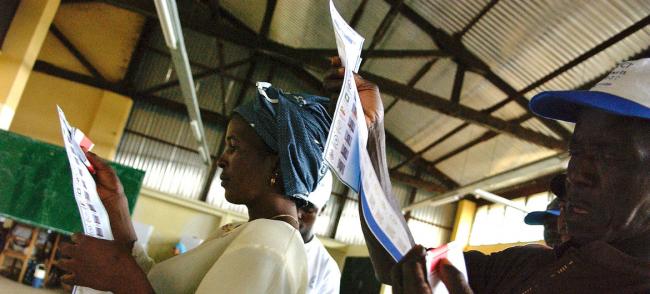
Democracy ‘showing greater strain’ than at any time in decades, UN chief
New York, Sept 15 (IBNS): Tackling economic and political inequality is at the root of strengthening democratic institutions at a time when they are under huge strain, said United Nations Secretary-General António Guterres on Saturday, marking the official International Day of Democracy.
“It means making our democracies more inclusive, by bringing the young and marginalized into the political system,” he continued. “It means making democracies more innovative and responsive to emerging challenges.”
The UN chief encouraged everyone to look for ways of invigorating democratic systems and values, calling on people everywhere to seek answers to the challenges facing democratic governments the world over.
Lamenting that democracy “is showing greater strain than at any time in decades,” he stressed that working for a future that leaves no one behind, requires everyone to consider essential questions, such as:
What impact will migration or climate change have on democracy in the next generation?
How do we best harness the potential of new technologies while avoiding the dangers?
How do build better governance so that democracy delivers better lives and fully meets the public’s aspirations?
Democracy is particularly close to the current Secretary-General’s heart. In his 20s, Mr. Guterres was part of the Carnation Revolution of 1974, in which Portugal overthrew its authoritarian dictatorship. He went on to become Prime Minister of his country, between 1995, and 2002.
More recently, he said in a magazine interview, that a central fact in today’s world is that democratic advances that he and other democratic leaders secured in the late 20th century, are in jeopardy, as are, more profoundly, the very values of the Enlightenment – also known as the Age of Reason, when the notion was embraced that humanity could be improved, through rational change.
“On this International Day of Democracy, let us commit to joining forces for the future of democracy,” concluded the Secretary-General in his message.
The theme for this year’s observance is “Democracy under Strain: Solutions for a Changing World.” Coinciding with the 70th anniversary of the Universal Declaration of Human Rights, the Day is also an opportunity to highlight the values of freedom and respect for human rights as essential elements of democracy.
Support Our Journalism
We cannot do without you.. your contribution supports unbiased journalism
IBNS is not driven by any ism- not wokeism, not racism, not skewed secularism, not hyper right-wing or left liberal ideals, nor by any hardline religious beliefs or hyper nationalism. We want to serve you good old objective news, as they are. We do not judge or preach. We let people decide for themselves. We only try to present factual and well-sourced news.
Support objective journalism for a small contribution.


