 Disabilities
Disability rights threatened by bad working conditions for carers: independent expert
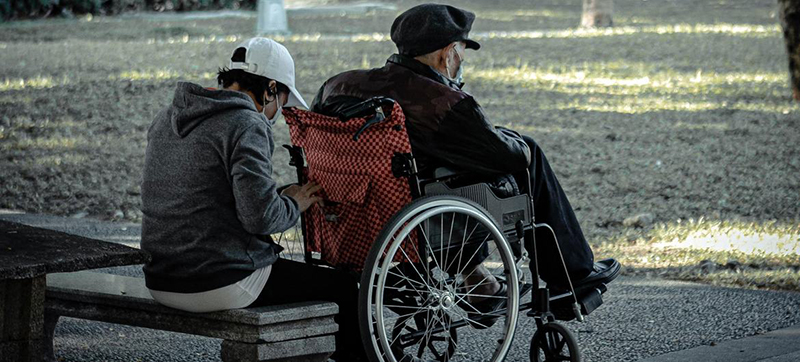
New York: Discussions about the “future of care in the 21st century” must prioritize working conditions and career opportunities – or else disability rights will be in jeopardy, a UN-appointed independent rights expert warned on Monday.
Gerard Quinn, the UN Special Rapporteur on the rights of persons with disabilities, said that “dead-end jobs, low wages, poor conditions and little room for social mobility” in the care sector are not a way to build resilient systems – as the COVID-19 pandemic has shown.
Women carers ‘severely disadvantaged’
Speaking at the opening of the latest session of the UN Committee on the Rights of Persons with Disabilities (CRPD) in Geneva, he highlighted the particularly unfavourable situation of women care workers.
“The ‘feminisation of poverty’ – whereby women carers are almost always severely disadvantaged – cannot continue,” he said, adding that being “serious” about rights meant that “we have to be serious about the ecosystem that gives them reality or that undermines them.”
Mr. Quinn stressed that discussions of disability rights did not exist in a vacuum and had to include a focus on women’s rights, as well as making service providers in the sector – a “multi-billion-dollar industry” – conscious that they too have a role to play in fulfilling human rights.
Disability and conflict
According to Mr. Quinn, far from being an “isolated or hermetically sealed instrument”, the UN Convention on the Rights of Persons with Disabilities “pressed a re-set button on so many areas – climate, conflict, development, democratisation”.
The Special Rapporteur previewed his upcoming report on conflict and disability to be launched in October, saying that he was “shocked” to learn that only six per cent of peace treaties in the last 30 years mention disability.
He deplored this “wasted opportunity” to build a more inclusive future at a pivotal moment in the life of any political community, insisting that it had to change – just like the fact that “official apologies, criminal accountability, reparations and memorialisation of past wrongs tend to exclude persons with disabilities”.
Special Rapporteurs are mandated by the UN Human Rights Council to monitor and report on specific thematic issues or country situations and work on a voluntary basis. They serve in their individual capacity, are not UN staff and do not receive a salary.
UN-wide policy guidance on care in the works
Also speaking at the CRPD opening on behalf of UN Human Rights (OHCHR), Ms. Asako Hattori said that the Office continued to work on the topic of inclusive care and support systems and was currently preparing a report on good practices for community inclusion of persons with disabilities, to be presented to the Human Rights Council next year.
She underscored that since April, the Office had been contributing to the development of a UN system-wide policy guidance on “care”.
According to OHCHR, there are an estimated one billion people with disabilities globally, or some 15 per cent of the world’s population.
To help advocate for their rights, the CRPD, a body of 18 independent experts, monitors the way countries have been implementing the Convention on the Rights of Persons with Disabilities and provides them with recommendations.
To this day, 187 States have ratified the Convention, which entered into force in 2008. During its current session, which will run until early September, the Committee will review the reports of Andorra, Austria, Germany, Israel, Malawi, Mauritania, Mongolia and Paraguay.
Support Our Journalism
We cannot do without you.. your contribution supports unbiased journalism
IBNS is not driven by any ism- not wokeism, not racism, not skewed secularism, not hyper right-wing or left liberal ideals, nor by any hardline religious beliefs or hyper nationalism. We want to serve you good old objective news, as they are. We do not judge or preach. We let people decide for themselves. We only try to present factual and well-sourced news.
Support objective journalism for a small contribution.