 Asia Pacific
‘Disaster emergency’ in Asia-Pacific, warns ESCAP
New York: Asia and the Pacific has a “narrow window” to protect its hard-won gains, as climate change supercharges disasters and impacts billions there, the UN’s development body spanning the vast region said on Tuesday.
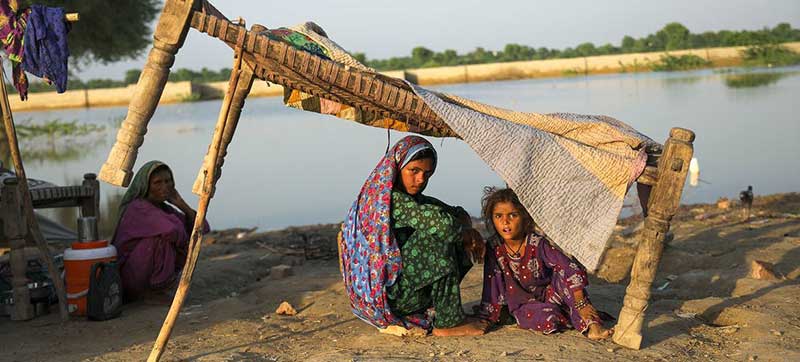
According to a new report from the UN Economic and Social Commission for Asia and the Pacific (ESCAP), in 2022 alone, over 140 disasters struck the region, leading to over 7,500 deaths.
They impacted 64 million people, and caused economic damage estimated at $57 billion.
Under a 2°C warming scenario, the ESCAP projects an increase in deaths and potential economic losses of more than $1 trillion, if there is no adequate response.
“As temperatures continue to rise, new disaster hotspots are emerging, and existing ones are intensifying,” Armida Salsiah Alisjahbana, Executive Secretary of ESCAP, said.
“A disaster emergency is underway, and we must fundamentally transform our approach to building resilience.”
Adaptation targets
The Asia-Pacific Disaster Report 2023, ESCAP’s flagship study on the changing patterns of disasters, their impacts, and building resilience, was launched at its Committee on Disaster Risk Reduction, which convenes governments, experts and stakeholders in the region.
This year it’s targeting transformative adaptation, to better safeguard vulnerable households and livelihoods in disaster-prone hotspots, ESCAP said.
The Committee is also expected to endorse a regional strategy to have early warning services up and running for all by 2027, in line with the UN Secretary-General’s pledge.
Harnessing innovation
New and evolving technologies, such as Artificial Intelligence (AI), big data, and cloud sourcing, also have a major role to play.
They are “very important and very strategic” for mitigating disaster risk, building resilience and strengthening climate action, Ms. Alisjahbana told UN News in an interview.
“These technologies can enhance our understanding of disaster patterns, bring early warning to all, and support decision making,” she added, referring to the latest update to ESCAP’s Disaster Risk and Resilience Portal, launched on Monday.
ESCAP’s mission
Informally known as the “parliament” of Asia-Pacific, ESCAP is one of UN’s five Regional Commissions focused on development in the region that is home to nearly two-thirds of the world’s population.
ESCAP’s 53 member States and 9 associate members span a geographic area from the Pacific island of Tuvalu in the east to Türkiye in the west, and Russia in the north to New Zealand in the south. Its non-regional members include France, the Netherlands, the UK and the US.
UN’s other Commissions cover West Asia, Africa, Europe, and Latin America and the Caribbean, respectively.
Support Our Journalism
We cannot do without you.. your contribution supports unbiased journalism
IBNS is not driven by any ism- not wokeism, not racism, not skewed secularism, not hyper right-wing or left liberal ideals, nor by any hardline religious beliefs or hyper nationalism. We want to serve you good old objective news, as they are. We do not judge or preach. We let people decide for themselves. We only try to present factual and well-sourced news.
Support objective journalism for a small contribution.