


FEATURE: at UN film screening, animal heist fable serves as poignant metaphor for Middle East relations
The award-winning production’s title is a cross between “giraffe” and “intifada” or Palestinian “uprising,” the director Rani Massalha told the UN News Centre in an interview ahead of the screening.
“The film is set during the second Intifada,” Massalha said, referring to a period of intensified Israeli-Palestinian violence from September 2000 to February 2005.
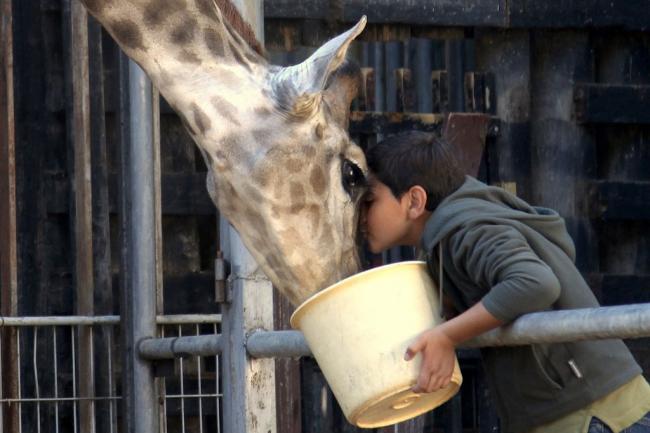
The film focuses on a widowed Palestinian veterinarian, Yacine, and his 10-year-old son, Ziad, who are trying to keep a giraffe named Rita from dying of loneliness after her partner is killed in an Israeli air raid. The only viable solution is for Rita to be placed in a zoo in Tel Aviv, Israel, or so it see
Created as a fable, the film shows “what it is to be a kid in West Bank on Wednesday living in war, living with a wall surrounding you, with checkpoints, colonies, it’s a very different childhood from people in the West,” the director said.
In one of the most emotional scenes in the film, a giraffe meanders through Palestinian streets, temporarily stopping day activities, such as shopping and praying, as people watch in jaw-dropping disbelief.
“The giraffe is the tallest animal in nature so it sees man from above looking down,” Massalha said, a reference to the height giving the animal perspective to see the situation in the Middle East as it is, not politicized.
The director also used giraffes as a metaphor for how the relationship between the Israelis and Palestinians could be, with two giraffes coming together from both sides of the West Bank barrier, known simply as the wall.
In this interview clip, Massalha discusses how he came up with the idea of having the world’s tallest land animal star in the film, and the connection with hope for peace in the Middle East.
In an interview with the UN News Centre, director Rani Massalha explains why a giraffe stars in his film, Giraffada
The screening was organized under the auspices of the UN Working Group of the Committee on the Exercise of the Inalienable Rights of the Palestinian People.
Deputy Permanent Representative of Malta to the United Nations and Chairperson of the Working Group, Natasha Meli-Daudey, said the film was chosen because of its portrayal of “the reality of the conflict and the impact of the Israeli occupation on the daily life of Palestinian adults and children.”
“We thought the film was well suited to inform a UN and broader New York audience about such topics,” she continued, adding that more than 500 people, including children, attended the screening.
The film’s human characters include different portrayals of Israeli and Palestinian personalities, often with fluid stereotypes. The characters include an Israeli veterinarian, who is actually played by an Arab actor of Moroccan descent, and whose help is integral to the plot’s success.
In contrast, there is an angry confrontation between the characters and a gun-wielding Israeli settler.
Despite it being a film with animals, shown through a child’s eyes, there are scenes that touch on the brutality of living in a war zone. Rather than give away the film’s ending, the UN News Centre asked Massalha to explain one of the scenes from the film.
Photo: Courtesy of Pyramide Films
Support Our Journalism
We cannot do without you.. your contribution supports unbiased journalism
IBNS is not driven by any ism- not wokeism, not racism, not skewed secularism, not hyper right-wing or left liberal ideals, nor by any hardline religious beliefs or hyper nationalism. We want to serve you good old objective news, as they are. We do not judge or preach. We let people decide for themselves. We only try to present factual and well-sourced news.
Support objective journalism for a small contribution.


