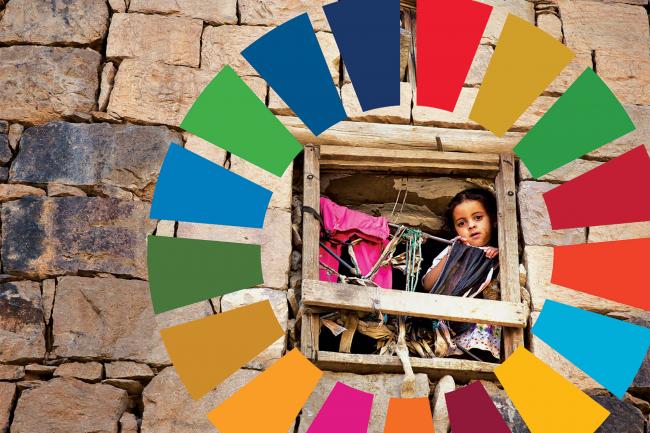
First progress report on Sustainable Development Agenda aims to leave no one behind
Officially launched by Secretary-General Ban Ki-moon at the ministerial meeting of the UN High-level Political Forum on Sustainable Development (HLPF) on Wednesday, the report was detailed on Wednesday to highlight its most important asset – the global data it contains.
“We have the chance to truly set the world on a different sustainable path leaving no one behind,” Assistant-Secretary-General for Policy Coordination and Inter-Agency Affairs, Thomas Gass, on Wednesday told the press in New York.
The annual Sustainable Development Goals Report is an opportunity “to review where the world stands at the start of this collective journey,” Gass added.
He then listed a number of figures – about 800 million people around the world live in extreme poverty and hunger, 5.9 million children die before they reach the age of five, 59 million of primary school age are out of school, 2.4 billion people still lack improved sanitation facilities, one in two children under the age of five lack birth certificates.
“It is crucial to build a global data ecosystem replete with quality reliable and timely data,” said Gass, speaking alongside Francesca Perucci, Chief of the Statistical Services Branch.
The global data is part of the 169 targets which will guide the plan of action for people, planet and prosperity from this year through 2030.
The Indicators were developed by experts representing 28 national statistical systems through an “open, inclusive and transparent process,” Gass said.
While the 17 Goals were universally accepted and approved by all 193 Member States last year, the indicators still have to be adopted by the UN’s Economic and Social Council and the General Assembly.
“The idea is that every country would provide the data – all the goals and all the targets are valid for all the countries,” Gass underscored in on Wednesday’s press conference.
This week’s report is the first progress report since the launch of the SDGs. Progress reports are expected every year for the next 14 years and will be presented to the High-level Political Forum, which is the UN’s central platform for the follow-up and review of the SDGs.
During his speech yesterday, Ban said he would convene an event on 21 September for countries to deposit their instruments of ratification on the Paris Agreement on climate change, an accord that was adopted in December last year and will enter into force when 55 countries ratify, and 55 per cent of global greenhouse gas emissions are accounted for.
In April, 178 countries signed the Paris Agreement at the UN Headquarters, and 19 countries have so far ratified. But these 19 countries accounted for less than 1 per cent of greenhouse gas emissions.
Ban encouraged at least 40 countries who committed that they will ratify this Paris Agreement before the end of this year, including the United States, China, Australia, Indonesia, Mexico, and Argentina.
He noted that a key feature of this year’s Forum is the voluntary national reviews, a mechanism that allows Governments to voluntarily present what they and their societies are doing to implement the 2030 Agenda. This year, 22 countries will share their experiences.
“Ensuring progress in achieving the SDGs will be greatly enhanced by making sure that lessons are shared and best practices are replicated,” he explained, calling on Member States to intensify efforts at follow-up and review through a participatory process, with the full engagement of the business sector and civil society.
Source: Sustainable Development Goals (SDGs) report.
Source: www.justearthnews.com
Support Our Journalism
We cannot do without you.. your contribution supports unbiased journalism
IBNS is not driven by any ism- not wokeism, not racism, not skewed secularism, not hyper right-wing or left liberal ideals, nor by any hardline religious beliefs or hyper nationalism. We want to serve you good old objective news, as they are. We do not judge or preach. We let people decide for themselves. We only try to present factual and well-sourced news.
Support objective journalism for a small contribution.