Global food accord aims to tackle hunger in protracted crises: UN agency
FAO said the new Framework for Action on Food Security and Nutrition in Protracted Crises offers guidance that signify “a marked shift from focus on short-term solutions, often humanitarian funded, to address long-term problems.”
“More comprehensive and effective policies and action will emerge as the result of the high-level political commitment the Framework mobilizes,” said Dominique Burgeon, FAO’s Strategic Programme Leader on Resilience.
Burgeon said that building resilience is a critical element of the Framework.
“Resilient communities have a greater capacity to absorb, prepare for and prevent crises and long-term stresses,” he said.
FAO also noted “that’s a marked shift from focus on short-term solutions, often humanitarian funded, to address long-term problems.”
Strengthening resilience, in all contexts, is vital to achieve the 2030 Sustainable Development Agenda just adopted last month by the UN General Assembly.
“We need to ‘do business differently’ in order to help the most vulnerable and at-risk communities to improve their food security and nutrition,” Burgeon said.
The prevalence of undernutrition is typically three times higher in protracted crises situations than in the rest of the developing world, according to FAO.
The Framework was approved by the Committee on World Food Security, which was set up in 1974 as an intergovernmental body to serve as a forum for review and follow up of food security policies.
The Framework comprises 11 principles that recognize the need for coherent and integrated humanitarian and development efforts to address both the immediate and the longer-term food security and nutrition needs of people in protracted crises.
It also emphasizes women’s empowerment and the agricultural productivity of smallholders, noting that both are often neglected in responses to crisis situations.
Over time, protracted crises reverse years of previously accumulated development gains, and undermine livelihoods, making the Sustainable Development Goal of eradicating hunger and poverty by 2030 harder to achieve.
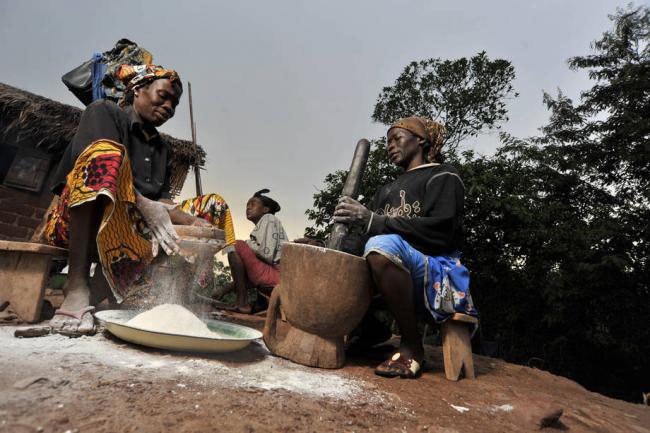
Photo: FAO/Riccardo Gangale
Support Our Journalism
We cannot do without you.. your contribution supports unbiased journalism
IBNS is not driven by any ism- not wokeism, not racism, not skewed secularism, not hyper right-wing or left liberal ideals, nor by any hardline religious beliefs or hyper nationalism. We want to serve you good old objective news, as they are. We do not judge or preach. We let people decide for themselves. We only try to present factual and well-sourced news.
Support objective journalism for a small contribution.