H-1B visa renewals may soon attract extra fees. What it means for Indians
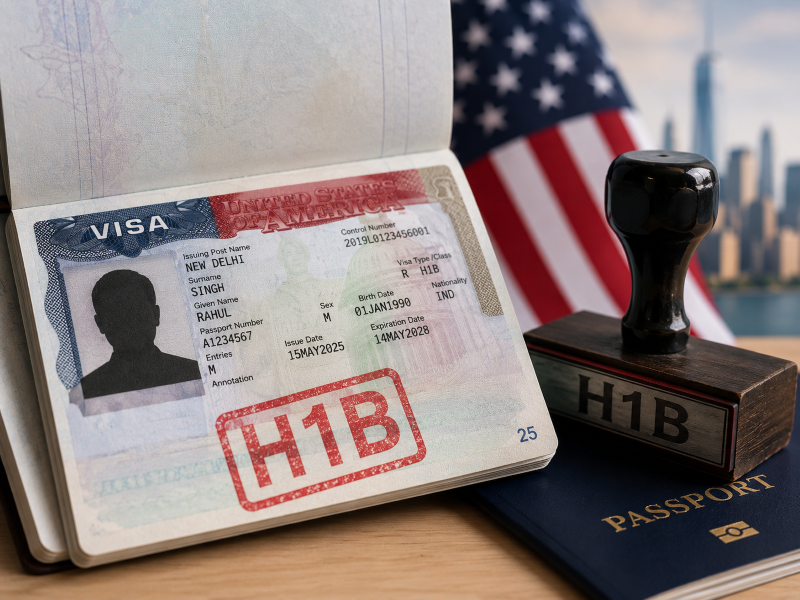
The Donald Trump administration is moving to make the H-1B visa regime more expensive by extending an additional visa fee to renewal petitions, a change that could significantly increase costs for companies retaining foreign workers in the US.
At present, the additional fee applies only to new H-1B and L-1 petitions and certain change-of-employer filings. Under a proposed rule, employers would also have to pay the fee when extending the stay of existing H-1B and L-1 employees.
The move is expected to disproportionately affect Indian professionals, who accounted for more than three-fourths of all H-1B visa extension approvals in fiscal year 2025.
Rule heads towards finalisation
The proposal, formally issued as a Notice of Proposed Rulemaking (NPRM), was first published by the Department of Homeland Security (DHS) and Customs and Border Protection (CBP) in June 2024 and appeared in the US Federal Register.
It later featured in the Trump administration's 2026 Unified Regulatory Agenda, released in early July, as a pending final rule.
The regulation is expected to be finalised in the coming weeks after review by the Office of Management and Budget (OMB) and the Office of Information and Regulatory Affairs (OIRA).
The proposal comes weeks after a US federal appeals court declined to pause a lower court order striking down the administration's separate decision to impose a $100,000 fee on certain new H-1B visas.
What changes under the proposal?
The proposed amendment would expand the scope of the 9-11 Response and Biometric Entry-Exit Fee, making it applicable not only to new H-1B and L-1 petitions but also to extension petitions filed for existing employees.
Currently, eligible employers pay the additional fee only when filing an initial H-1B or L-1 petition or when an H-1B worker changes employers. If the rule is finalised, the same employers would also have to pay the fee each time they seek to renew an employee's visa.
The proposal targets employers with 50 or more employees in the US, where more than half of the workforce holds H-1B or L-1 status.
Such employers currently pay an additional $4,000 for qualifying H-1B petitions and $4,500 for qualifying L-1 petitions. Those charges would now extend to routine visa renewals.
Indian professionals likely to be most affected
The proposal is expected to have the biggest impact on Indian professionals because they account for the overwhelming majority of H-1B extension approvals.
According to US Citizenship and Immigration Services (USCIS) data, the agency approved 406,348 H-1B petitions in fiscal year 2025. Of these, 291,542, or nearly 72%, were for continuing employment.
Indian nationals accounted for 226,359 of those approvals, representing 77.6% of all H-1B extensions.
If implemented, employers with large Indian workforces—particularly in the technology sector—would face significantly higher costs to retain skilled employees already working in the US.
Tech giants among firms facing higher costs
Large technology companies and IT services firms are expected to bear the brunt of the proposal.
According to the National Foundation for American Policy (NFAP), Amazon recorded the highest number of approved H-1B petitions for continuing employment in fiscal year 2025 with 14,532 approvals. It was followed by Tata Consultancy Services (5,293), Microsoft (4,863), Meta (4,740), Apple (4,610) and Google (4,509).
NFAP notes that these figures represent approved petitions rather than individual employees, as a worker may receive multiple approvals in a single year because of transfers or amended filings.
Why DHS wants the change
The proposal revives a policy finalised by DHS in 2020 that was never implemented after being blocked in court.
According to DHS, the current interpretation allows many covered employers to avoid paying the additional fee when employees remain with the same company, even though Congress intended the charge to apply more broadly to extension-of-stay petitions.
The department says expanding the fee would better align with congressional intent while helping fund the US biometric entry-exit system, which relies on facial recognition and other biometric technologies to track travellers entering and leaving the country.
DHS estimates the proposal would generate an additional $157.3 million annually, while continuing to apply only to employers with at least 50 US employees where more than half of the workforce holds H-1B or L-1 visas.
If approved, the rule would add another financial burden on large employers that rely heavily on skilled foreign workers, particularly in the technology sector, where visa renewals account for the majority of H-1B approvals.
Support Our Journalism
We cannot do without you.. your contribution supports unbiased journalism
IBNS is not driven by any ism- not wokeism, not racism, not skewed secularism, not hyper right-wing or left liberal ideals, nor by any hardline religious beliefs or hyper nationalism. We want to serve you good old objective news, as they are. We do not judge or preach. We let people decide for themselves. We only try to present factual and well-sourced news.
Support objective journalism for a small contribution.