Haiti: UN determined to support authorities in strengthening rule of law
New York, Feb 17 (JEN): Strengthening the rule of law and improving the national police and the judicial system in Haiti will require political will on the part of the authorities, and the United Nations is determined to support this goal, said Assistant Secretary-General for Peacekeeping Operations Bintou Keita.
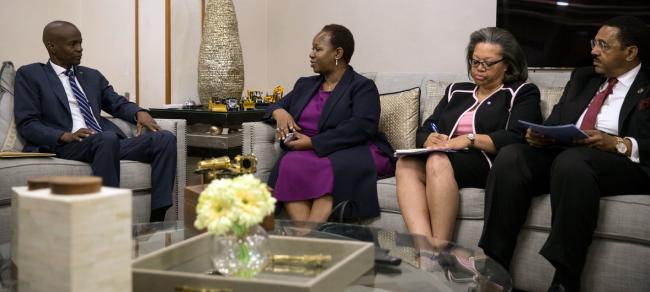
Keita, who took up her post last September, traveled to Haiti from 5 to 9 February to support the efforts of the new UN Mission for the Support of Justice in Haiti (MINUJUSTH), to discuss the Mission’s mandate with the Haitian Government and other partners, and to ensure that human rights are at the heart of the country’s sustainable development agenda.
Established in October 2017, MINUJUSTH succeeded a previous UN peacekeeping mission, known as MINUSTAH, with a smaller mandate from the Security Council, focused on helping the Haitian Government strengthen its rule-of-law institutions.
In an interview with UN News, Keita said that the Security Council has given the Mission a brief two-year timeframe, starting in April 2018, to help Haiti overcome “systemic problems” and “to ensure that fundamental progress is taking place in the justice sector, the judiciary, security and human rights.” She added that all interlocutors in Haiti agreed that the judiciary was the weakest of the three branches of Government.
Her visit focused mainly on discussing the milestones, or benchmarks, that will make it possible to measure the gradual assumption of responsibilities by the Haitian authorities of those critical rule-of-law issues, to allow the Security Council to withdraw the peacekeeping presence all together by Spring 2020.
The Assistant Secretary-General also made a field visit to Jeremie, in the south-west of the country, to see and hear for herself the realities on the ground, where MINUJUSTH mobile teams engage with the local communities to hear how the justice system works in practice. She described her “emotional” visit to a civilian prison, where she saw the living conditions of the prisoners, the majority of whom are on pre-trial detention.
“The overall system is really showing the symptoms of a sick system and dysfunctional system ... It’s been years since the diagnosis was made. What we need now is a real political will to address the issues that will allow to deliver real change and create trust between the people and the justice system,” she said.
The next steps for MINUJUSTH and Haiti, as Keita said in her joint statement on 9 February with President Jovenel Moïse, is to move forward in partnership and seize the opportunity of the Mission’s presence over the next two years to consolidate gains and to redouble efforts to achieve ambitious but realistic common goals, thus preparing the exit strategy for the peacekeeping operation.
Efforts will focus on the fight against impunity and corruption, on improvements to the judicial system, and on measures in the field of preventive detention.
According to Keita, strengthening the institutions of the rule of law is a long-term goal. In the short term, however, the goal is to “show visible results” so that people can regain confidence in the will of the authorities “to do things with the support of the international community.”
MINUJUSTH/Leonora Baumann
Support Our Journalism
We cannot do without you.. your contribution supports unbiased journalism
IBNS is not driven by any ism- not wokeism, not racism, not skewed secularism, not hyper right-wing or left liberal ideals, nor by any hardline religious beliefs or hyper nationalism. We want to serve you good old objective news, as they are. We do not judge or preach. We let people decide for themselves. We only try to present factual and well-sourced news.
Support objective journalism for a small contribution.