Haiti: UN-supported supply system provides clean water to remote community
A remote area mainly consisting of dry mountains, Los Palis is located 15 minutes away from the city centre of Hinche. Life for the inhabitants of this isolated community – divided into several areas, including Los Palmas, Jacob and Guébo – has never been easy. Residents lack some basic necessities and struggle with a lack of access to electricity, health services, roads and especially drinking water.
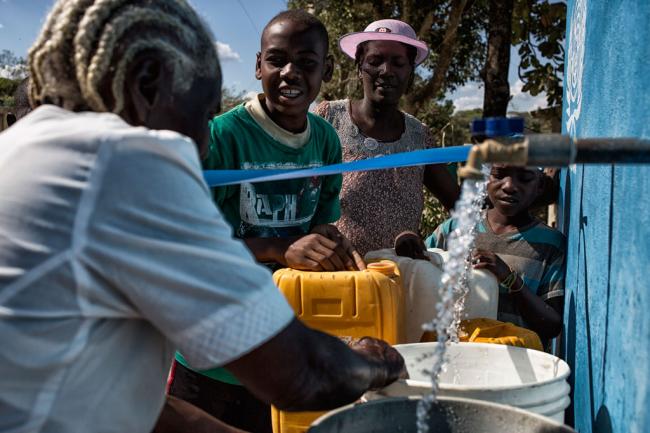
People from Los Palis, particularly women and children, walk miles to bring home drinking water to prevent their relatives from being exposed to poor quality water and water-related diseases.
In the rainy season, the village draws water from sources such as ponds formed by overflowing nearby rivers. Unsafe water often results in frequent cases of diseases such as typhoid, diarrhoea, dysentery, cholera, or vaginal and other water-related infections.
To end the suffering of the residents of Los Palis, MINUSTAH financed the third phase of a water supply project aiming at serving more than 18,000 people, more than 53 per cent of whom are women. Inaugurated last Thursday, the supply system received $95,671 through a quick-impact projects programme enabling MINUSTAH to support Haitian authorities in improving public infrastructure and living conditions.
“In 2014, the Secretary-General of the United Nations came to Los Palmas. He saw the situation in relation to water, cholera and other diseases, and he announced a programme, the third phase of which we are inaugurating now,” said the Mission’s deputy chief, Mourad Wahba, who is also the UN Resident and Humanitarian Coordinator in Haiti, at the project’s inauguration.
Wahba underlined that the project benefited from MINUSTAH’s contribution but also from the Secretary-General’s new approach to eliminate cholera and all water-borne diseases in Haiti. “The best way to do this is through drinking water, sanitation and vaccination projects,” he added.
The new approach to tackling the disease will centre on two different elements, known as ‘Track One’ and ‘Track Two.’
‘Track One’ consists of a greatly intensified and better-resourced effort to respond to and reduce the incidence of cholera, through addressing Haiti’s short- and longer-term issues of water, sanitation and health systems and improved access to care and treatment.
‘Track Two’ of the approach is the development of a package of material assistance and support to those Haitians most directly affected by cholera, centred on the victims and their families and communities. It is expected that it will also involve affected individuals and communities in the development of the package.
Haiti has been dealing with a cholera outbreak since October 2010, some nine months after it suffered a devastating earthquake. The outbreak has affected an estimated 788,000 people and claimed the lives of more than 9,000. Concerted national and international efforts, backed by the United Nations, have resulted in a 90 per cent reduction in the number of suspected cases.
Photo: UN/MINUSTAH
Source: www.justearthnews.com
Support Our Journalism
We cannot do without you.. your contribution supports unbiased journalism
IBNS is not driven by any ism- not wokeism, not racism, not skewed secularism, not hyper right-wing or left liberal ideals, nor by any hardline religious beliefs or hyper nationalism. We want to serve you good old objective news, as they are. We do not judge or preach. We let people decide for themselves. We only try to present factual and well-sourced news.
Support objective journalism for a small contribution.