


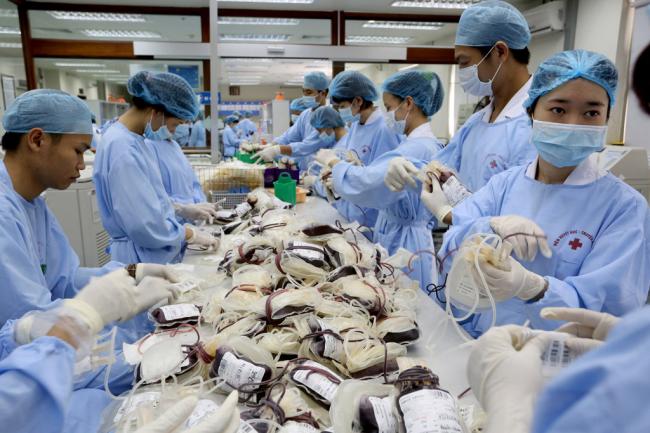
Increase in voluntary blood donors can save millions of lives: WHO
“The best way to guarantee a safe and adequate supply of blood and blood products for transfusion is to have a good supply of regular donations by voluntary unpaid blood donors,”said WHO Director-General Dr. Margaret Chan in the agency's press release on the Day, which is marked every year on 14, June.
“We encourage all Member States to obtain their blood supplies from such donors.”
The theme of this year's campaign is Thank You for Saving My Life, with the slogan, 'Give freely, give often. Blood donation matters.' The host country for World Blood Donor Day is China, which will host a global event today at the Shanghai Blood Centre.
Transfusion of blood and blood products helps patients suffering from life-threatening conditions to live longer and maintain a higher quality of life, and it supports complex medical and surgical procedures.
It has an essential, life-saving role in maternal and child care and during man-made and natural disasters, such as the recent earthquakes in Nepal.
Severe bleeding during pregnancy, delivery or after childbirth is the single biggest cause of maternal death.
Of the 289 000 women who died in childbirth in 2013 due to complications in pregnancy and childbirth, 27 per cent were due to severe bleeding.
“Blood collection from voluntary, unpaid donors, whose blood is screened for infections, is the cornerstone of a safe and sufficient blood supply in all countries,” says Dr. Hernan Montenegro, who works at the Department of Service Delivery and Safety at WHO.
He said, “More voluntary blood donors are needed to meet the increasing needs and to improve access to this life-saving therapy.”
The percentage of blood donations from voluntary unpaid donors has been increasing over the last decade and 73 of the world's countries now collect over 90 per cent of their blood supply from such donors.
However, more progress is needed, with 72 countries still collecting more than half of their blood supply from paid donors or replacement donors, which affects safety and adequate supply of blood and blood products. Replacement donors are often family members or friends who replenish blood used from a blood bank by a particular patient.
“Safe blood transfusion is one of the key life-saving interventions that should be available for patients in need,” says Dr. Edward Kelley, Director of Service Delivery and Safety at WHO.
He added, “Yet, equitable access to safe blood still remains a major challenge in many countries. Providing safe and adequate supplies of blood and blood products should be an essential part of every country's national health care policy and infrastructure.”
WHO provides policy guidance and technical assistance to support countries in developing national blood systems based on voluntary unpaid blood donations, and implementing quality systems to ensure that safe and quality blood and blood products are available and used appropriately for all people who need them.
Photo: World Bank/Dominic Chavez
Support Our Journalism
We cannot do without you.. your contribution supports unbiased journalism
IBNS is not driven by any ism- not wokeism, not racism, not skewed secularism, not hyper right-wing or left liberal ideals, nor by any hardline religious beliefs or hyper nationalism. We want to serve you good old objective news, as they are. We do not judge or preach. We let people decide for themselves. We only try to present factual and well-sourced news.
Support objective journalism for a small contribution.


