Korean nuclear crisis, Middle East quagmire eroding global security, UN chief tells Munich summit
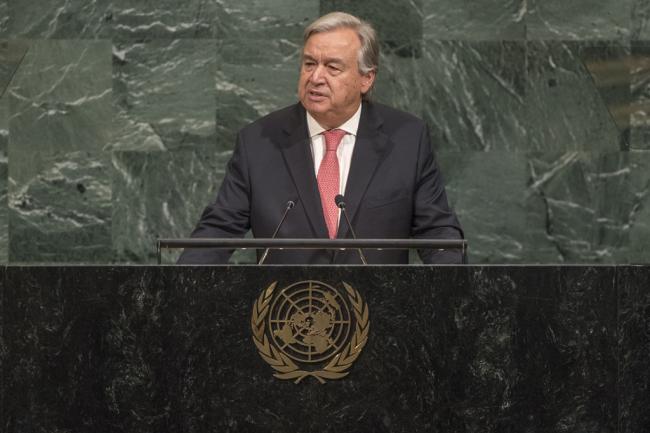
New York, Feb 17 (JEN): A nuclear threat on the Korean Peninsula and a quagmire in the Middle East are “two qualitative changes” that further eroded global security over the past year, United Nations Secretary-General António Guterres told an annual conference on international security policy in Munich, Germany.
“Conflicts are becoming more and more interrelated and more and more related to a set of a new global terrorism threat to all of us,” Guterres said in his keynote address at the opening ceremony on Friday of the Munich Security Conference.
For the first time since the end of the Cold War, the world is facing the threat of nuclear weapons and long-range missiles posed by the Democratic People’s Republic of Korea (DPRK), which he called “a development made in total contradiction to the will of the international community and in clear violation of several resolutions of the Security Council.”
He said that it was essential to maintain “meaningful pressure over North Korea” to create an opportunity for diplomatic engagement on the peaceful denuclearization of the Korean peninsula within a regional framework.
“The two key stakeholders in relation to this crisis, the United States and [DPRK]” must be able to “come together and have a meaningful discussion on these issues,” he said, adding that it is “important not to miss the opportunity of a peaceful resolution through diplomatic engagement as a military solution would be a disaster with catastrophic consequences that we cannot even be able to imagine.”
The situation in the broader Middle East, which the UN chief said had become a “Gordian knot,” was also eroding global security, with that are crises that are “crossing each other and interconnected.”
Pointing to the Palestinian-Israeli conflict, and wars in Syria, Yemen and Libya, among others, Guterres said the entire Middle East has “became a mess,” with varied and intersecting fault lines.
He warned of the absence of a common vision in the region and said that even if interests are contradictory, the threats these conflicts represent would justify some efforts to come together.
Turning to cyber-security, Guterres called for a serious discussion about the international legal framework in which cyberwars take place.
“I can guarantee that the United Nations would be ready to be a platform in which different actors could come together and discuss the way forward, to find the adequate approaches to make sure that we are able to deal with the problem of cybersecurity,” he said, noting that artificial intelligence provides “enormous potential for economic development, social development and for the well-being for all of us.”
The Secretary-General said that Governments and others have been unable to manage human mobility. He warned that this had created mistrust and doubts about globalism and multilateralism.
“This is a reason why,” he said, “we need to be able to unite, we need to be able to affirm that global problems can only be addressed with global solutions and that multilateralism is today more necessary than ever.”
UN Photo/Cia Pak
Support Our Journalism
We cannot do without you.. your contribution supports unbiased journalism
IBNS is not driven by any ism- not wokeism, not racism, not skewed secularism, not hyper right-wing or left liberal ideals, nor by any hardline religious beliefs or hyper nationalism. We want to serve you good old objective news, as they are. We do not judge or preach. We let people decide for themselves. We only try to present factual and well-sourced news.
Support objective journalism for a small contribution.