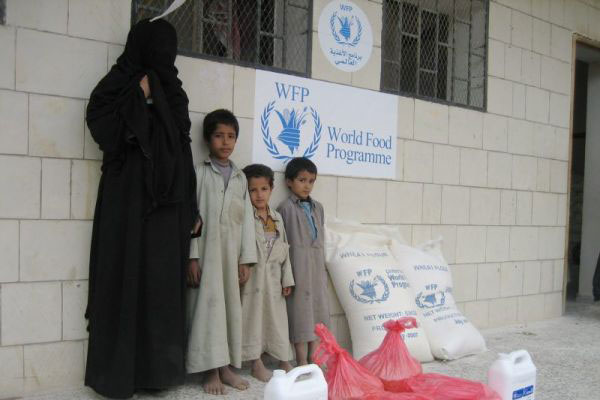
Millions of Yemenis face food insecurity amid escalating conflict: FAO
“We are entering a crucial period for crop production in Yemen and now, more than ever, agriculture cannot be an afterthought if we want to prevent more people from becoming food insecure amidst this crisis,” said FAO Representative for Yemen, Salah Hajj Hassan.
According to the agency’s latest assessment, increasing conflict in nearly all major towns across the country is disrupting markets and trade, driving up local food prices and hampering agricultural production, including land preparation and planting for the 2015 harvests.
Some 10.6 million Yemenis are now severely food insecure, of which 4.8 million are facing “emergency” conditions, suffering from severe lack of food access, very high malnutrition, and irreversible destruction of livelihoods. Around 850,000 children are acutely malnourished.
More than half of Yemen’s population – some 16 million out of a total of 26 million – is in need of some form of humanitarian aid and has no access to safe water.
The latest escalation of conflicts is expected to further increase food insecurity in the poverty-stricken country. Paradoxically, some 2.5 million food producers, including farmers, pastoralists, fishermen and agricultural wage labourers, are among those identified as food insecure.
“Even before fighting intensified this spring, Yemenis were in dire need of support to build up their agricultural production,” said Abdessalam Ould Ahmed, FAO Assistant Director-General for North Africa and the Near East.
“The deteriorating situation means we need to double down on our efforts to ensure that as many farmers as possible are able to plant this growing season and strengthen their ability to withstand future shocks,” he added.
In some areas of the country, food prices have doubled and fuel prices have quadrupled. Further increases are expected as a result of fuel shortages and the impact of civil unrest on imports and transportation networks across Yemen.
FAO and its partners have since 2014 been working to support local farmers and internally displaced people to strengthen their livelihoods by distributing crop production packages, home gardening kits and fisheries inputs.
Since 2014, more than 90,000 people have benefited from these FAO programs. Security conditions permitting, the Organization aims to reach nearly 235,000 people through its 2014 to 2015 response plan for the Gulf nation, but more funding is needed. Currently, only $4 million of the required $12 million have been made available for the livelihood programs.
Photo: WFP/Atheer Najim
Support Our Journalism
We cannot do without you.. your contribution supports unbiased journalism
IBNS is not driven by any ism- not wokeism, not racism, not skewed secularism, not hyper right-wing or left liberal ideals, nor by any hardline religious beliefs or hyper nationalism. We want to serve you good old objective news, as they are. We do not judge or preach. We let people decide for themselves. We only try to present factual and well-sourced news.
Support objective journalism for a small contribution.