More than 5,000 child soldiers released in 2017, but tens of thousands still being used in conflict - UN
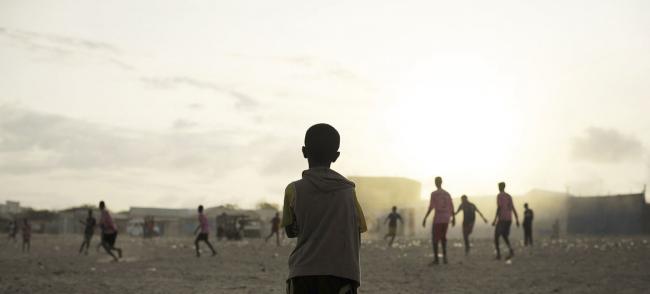
New York, Feb 13 (JEN): The global commitment to end the use of children in armed conflict led to the release and reintegration of more than 5,000 children in 2017, but tens of thousands of boys and girls are still being recruited, kidnapped, and forced to fight or work for military groups or armed forces at “alarming rates,” according to the United Nations.
“Children can only be freed from armed groups and forces through a comprehensive reintegration process, including medical and psycho-social support, as well as educational programmes and trainings,” the Special Representative of the UN Secretary-General for Children and Armed Conflict, Virginia Gamba, said Monday, on the International Day against the Use of Child Soldiers.
“Without a strong political and financial commitment to the reintegration process, re-recruitment is unfortunately likely to happen in many conflict situations,” Gamba added.
Despite progress, boys and girls continue to be recruited, kidnapped, forced to fight or work for military groups or armed forces. The recruitment and use of children happened in all 20 country situations covered by the mandate entrusted to Ms. Gambia and her office.
Sixty-one parties to conflict out of 63 are listed for this grave violation in the 2016 Annual Report of the Secretary-General on the issue, making it by far the most widely-spread violation.
“It is our responsibility to show these children that there is hope outside of conflicts, that they can live in peace and security and be allowed to live their dreams,” Gamba, reminded.
The International Day was initiated in 2002 when the Optional Protocol to the Convention on the Rights of the Child on the Involvement of Children in Armed Conflict entered into force on February 12, 2002. This protocol, which sets the minimum age for recruitment into armed forces in conflict at 18, has been ratified by 167 States.
Is the international approach fit-for-purpose?
Meanwhile, the United Nations University (UNU) has been collaborating with the UN Children’s Fund (UNICEF), the UN Department of Peacekeeping Operations, Luxembourg and Switzerland, to examine whether the international community’s approach to this scourge is effective, or requires adjustments.
The goal is to use the empirical findings of the research to inform programmatic guidance for actors in the field and to effectively disengage children from armed groups.
In their report, titled Cradled by Conflict: Child Involvement with Armed Groups in Contemporary Conflict, researchers suggest that most children do not so much “opt” into conflict as “grow” into it.
According to the report, conflict structures the information they see and the choices they make. It pulls and pushes them in many directions. Conflict erodes their relationships. It exacerbates their needs and exposes them to untold risks. Conflict shapes their identity and heightens their need to find meaning in their lives.
Ultimately, the forces of conflict narrow the paths available to children, and tragically, for many, lead to exploitation, violence, and trauma.
These findings undermine the conventional wisdom that “violent extremism” or ideology is predominantly responsible for driving children into armed groups.
The report proposes five principles for more effective international efforts to prevent and respond to child recruitment and use by armed groups: avoid programmes focused primarily on ideological factors; only incorporate ideological components where individually necessary and where they can be embedded into larger, holistic efforts to address the needs and risks of children; ensure all interventions are empirically based; rigorously assess interventions over the long term; and engage children not just as beneficiaries, but as partners.
UN Photo/Tobin Jones
Support Our Journalism
We cannot do without you.. your contribution supports unbiased journalism
IBNS is not driven by any ism- not wokeism, not racism, not skewed secularism, not hyper right-wing or left liberal ideals, nor by any hardline religious beliefs or hyper nationalism. We want to serve you good old objective news, as they are. We do not judge or preach. We let people decide for themselves. We only try to present factual and well-sourced news.
Support objective journalism for a small contribution.