Nepal: UN races humanitarian relief to quake-affected communities
“The momentum is there,” said Jamie McGoldrick, the UN Humanitarian Coordinator in Nepal, in a press release issued on Monday.
He said, “Considering the conditions and complexities, we are now well-positioned to assist all the affected communities.”
The 25 April earthquake, and its 7.3 magnitude follow-up on 12 May, damaged 26 of Nepal's hospitals and over 1,100 health facilities while affecting some 5.6 million people, half of whom have been displaced.
An estimated 8,500 people were killed by the two quakes.
In addition, the UN's Office for the Coordination of Humanitarian Affairs (OCHA) has confirmed that 8.1 million people are in need of humanitarian support while another 1.9 million require food assistance.
Nevertheless, among the major obstacles facing emergency responders is Nepal's unique and challenging mountainous topography which has rendered many affected communities difficult to reach.
According to OCHA, some 315,000 people in the 14 most affected districts remain in areas inaccessible by road while 75,000 others cannot even be reached by air.
With monsoon season no more than three weeks away, time is now of the essence as affected communities – without shelter and short on food supplies – remain more vulnerable than ever to potential landslides and torrential rains, the UN has warned.
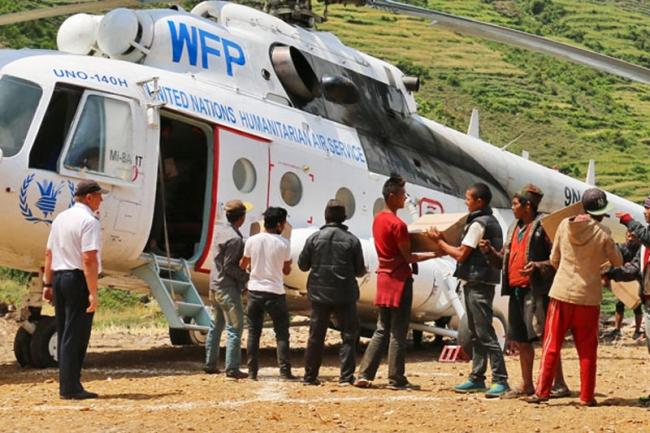
As a result, OCHA has reported that elite climbers and porters have joined the relief efforts, setting off on foot from humanitarian staging areas where aid is dropped off in order to optimize delivery to the more hard-to-reach areas.
“We don't have much time left to achieve what we set out to accomplish,” McGoldrick continued.
He added, “But with the right support at the right time, we can assist people who desperately need our help, even those in the remote hard-to-reach places.”
Against that backdrop, however, there is also growing concern that international funding for the humanitarian response is, to date, insufficient.
In Monday's press release, OCHA warned that only $92.4 million, or 22 per cent of what is required for the response, was received against the $423 million humanitarian appeal.
Photo: WFP/Angeli Mendoza
Support Our Journalism
We cannot do without you.. your contribution supports unbiased journalism
IBNS is not driven by any ism- not wokeism, not racism, not skewed secularism, not hyper right-wing or left liberal ideals, nor by any hardline religious beliefs or hyper nationalism. We want to serve you good old objective news, as they are. We do not judge or preach. We let people decide for themselves. We only try to present factual and well-sourced news.
Support objective journalism for a small contribution.