New report signals progress towards malaria elimination: WHO
According to the World Malaria Report 2015, released on Wednesday, more than half (57) of the 106 countries with malaria in 2000 had achieved reductions in new malaria cases of at least 75 per cent by 2015. In that same time frame, 18 countries reduced their malaria cases by 50-75 per cent.
“Since the start of this century, investments in malaria prevention and treatment have averted over 6 million deaths,” said WHO Director-General Dr. Margaret Chan. “We know what works. The challenge now is to do even more.”
An estimated 663 million cases of malaria have been averted in sub-Saharan Africa since 2001 as a direct result of the scale-up of three key malaria control interventions: insecticide-treated mosquito nets, indoor residual spraying and artemisinin-based combination therapy, the report said.
The new estimates from WHO also show that across sub-Saharan Africa, the prevention of new cases of malaria has resulted in major cost savings for endemic countries.
New estimates presented in the report show that reductions in malaria cases attributable to malaria control activities saved an estimated $900 million in case management costs in the region between 2001 and 2014.
And for the first time since WHO began keeping score, the European Region is reporting zero indigenous cases of malaria.
In 2014, 16 countries reported zero indigenous cases of malaria: Argentina, Armenia, Azerbaijan, Costa Rica, Iraq, Georgia, Kyrgyzstan, Morocco, Oman, Paraguay, Sri Lanka, Tajikistan, Turkey, Turkmenistan, United Arab Emirates and Uzbekistan.
Despite the progress, there is “still a long road” towards elimination, the report said.
“Globally, about 3.2 billion people – nearly half of the world’s population – are at risk of malaria,” WHO said. “In 2015, there were estimated 214 million new cases of malaria, and approximately 438,000 deaths.”
The report said 15 countries, mainly in Africa, account for most global malaria cases (80 per cent) and deaths (78 per cent) with two countries, Nigeria and Democratic Republic of Congo (DRC), accounting for more than 35 per cent of global malaria deaths in 2015.
According to the report, these high burden countries have achieved slower-than-average declines in malaria incidence (32 per cent) compared to other countries globally (53 per cent).
“In many of these countries, weak health systems continue to impede progress in malaria control,” the agency said.
Approximately one third of people at risk of malaria in sub-Saharan Africa lived in households that lacked protection from mosquito nets or indoor residual spraying.
WHO noted that the “progress has resulted, in large part, from the massive deployment of effective and low-cost malaria control interventions.”
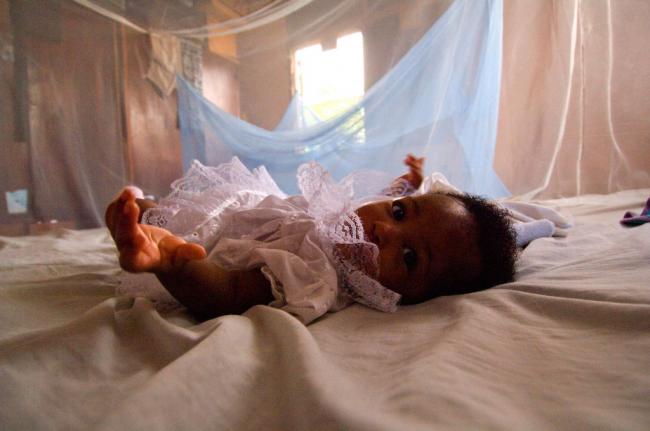
For example, since 2000, nearly 1 billion insecticide-treated mosquito nets have been distributed in sub-Saharan Africa, and by 2015, about 55 per cent of the population in this region was sleeping under mosquito nets, up from less than 2 per cent coverage in 2000.
Rapid diagnostic tests have made it easier to swiftly distinguish between malarial and non-malarial fevers, enabling timely and appropriate treatment, the agency also note.
But even as progress was being made WHO warned of “new challenges” on the horizon.
“In many countries, progress is threatened by the rapid development and spread of mosquito resistance to insecticides,” said Dr. Pedro Alonso, Director of the WHO Global Malaria Programme. “Drug resistance could also jeopardize recent gains in malaria control.”
Photo: World Bank/Arne Hoel/www.justearthnews.com
Support Our Journalism
We cannot do without you.. your contribution supports unbiased journalism
IBNS is not driven by any ism- not wokeism, not racism, not skewed secularism, not hyper right-wing or left liberal ideals, nor by any hardline religious beliefs or hyper nationalism. We want to serve you good old objective news, as they are. We do not judge or preach. We let people decide for themselves. We only try to present factual and well-sourced news.
Support objective journalism for a small contribution.